Recently updated on November 2nd, 2025 at 8:48 pm
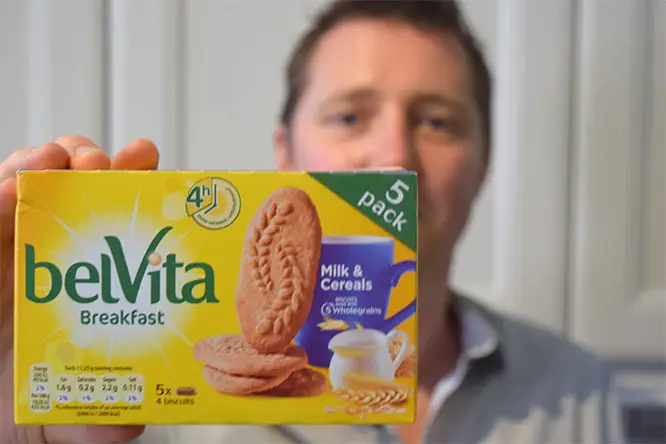
by Neil Welsh
I wouldn’t be surprised if you already have formed an opinion about BelVita breakfast biscuits before reading this review. The marketing claims state that Belvita Breakfast Biscuits provide 4 hours of nutritious steady energy but many people see these products as processed junk that are designed for people who buy their breakfast from petrol stations.
To be honest, I definitely had a preconceived opinion about BelVita. The idea of biscuits for breakfast just doesn’t seem right at first, especially in a world dominated by food fixations. They are processed, have a huge list of ingredients and, well, they have the word biscuit in the title. Biscuits aren’t breakfast food, are they? Or are they? Time for a closer look to see what the nutritional claims are, what the reality is and try to work out if they are healthy or not.
So, are BelVita biscuits actually healthy?
Not really. They’re okay for a quick breakfast on the go, but I wouldn’t call them healthy. They’re mostly made from wheat flour with some wholegrains thrown in, plus added sugar and oils. You do get a bit of fibre and some added minerals, but they’re still a processed food at the end of the day.
If you have them occasionally, it’s not the end of the world – just don’t rely on them as your regular breakfast.
What’s hiding in the ingredients list
Let’s take a look at what’s actually in those breakfast biscuits. I’m talking about the regular BelVita Breakfast range – the ones that come in a pack of four, not the soft bakes.
I checked three popular flavours: Milk & Cereals, Cocoa Chocolate Chip, and Honey & Nut with Chocolate Chips. They all look slightly different on the packet, but the ingredients are almost identical.
Each one is made mostly from cereals (about 56–71%), mainly wheat flour (around 40–50%) with roughly 20% wholegrains. Those wholegrains come from oats, barley, rye and spelt – which sounds good, but they’re still not the main ingredient.
Here’s what else you’ll find in a typical pack:
- Sugar – appears high on the list in every flavour.
- Rapeseed oil – adds fat and keeps the biscuits crisp.
- Polydextrose – a fibre additive used to bulk things up.
- Raising agents – things like ammonium and sodium carbonates (sounds more like chemistry than breakfast).
- Emulsifiers – such as soya lecithin to hold everything together.
- Flavour extras – cocoa, honey, milk powders or hazelnuts, depending on the variety.
- Added minerals – calcium, magnesium and iron, to help justify that “source of vitamins and minerals” label on the box.
On the plus side, belVita do say their biscuits don’t contain colours or preservatives – that’s straight from their UK FAQ. But you’ll still see “flavourings” on packs (not specified), and some non-breakfast products like the Soft Bakes Strawberry use glucose-fructose syrup, so it’s not an “all natural” situation.
So while you do get some wholegrains and added nutrients, these biscuits are still processed food made mostly from refined flour and sugar. Convenient? Definitely. Healthy? Not so much.
The Nutritional Lowdown
If you look at the labels, the numbers don’t vary much between flavours. Here’s how the main BelVita Breakfast biscuits compare per 100g:
| Nutrient (per 100g) | Milk & Cereals | Cocoa Chocolate Chip | Honey & Nut with Chocolate Chips |
|---|---|---|---|
| Calories | 443 kcal | 439 kcal | 447 kcal |
| Sugar | 20 g | 27 g | 22 g |
| Fat | 14 g | 14 g | 15 g |
| Saturated fat | 1.6 g | 3.6 g | 1.8 g |
| Fibre | 6.4 g | 6.8 g | 7.6 g |
| Protein | 8.1 g | 7.9 g | 7.7 g |
| Added minerals | Calcium, Magnesium, Iron | Calcium, Magnesium, Iron | Calcium, Magnesium, Iron |
Which one’s the healthiest?
Looking at the table above, Milk & Cereals comes out as the slightly better balanced option of the three. It’s a touch lower in sugar and saturated fat, while the calories are about the same.
Cocoa Chocolate Chip is the sweetest, and Honey & Nut the highest in fat. None are especially light, but if you want the least sugary choice, Milk & Cereals wins.
If you’re after something a little better from the same range, the BelVita Breakfast Choc Chips 30% Less Sugar version is your best bet. It’s below 20 g of sugar per 100 g, which is actually quite good for this type of biscuit.
Outside of the breakfast range, the Soft Bake Strawberry filled bars are worth mentioning too. They come in under 400 calories per 100 g and have about 18 g of sugar, so if you’re watching your weight, they’re lighter overall (one bar is around 50 g or 184 kcal).
Nutrition per pack (what you actually eat)
A single pack of four Belvita biscuits (45 g) gives you roughly:
- 200 calories
- 9–12 g of sugar (around two to three teaspoons)
- 6–7 g of fat, with less than 1 g saturated
- 3–4 g of protein
- A small amount of fibre (about 3 g)
That’s roughly the same calories as two slices of toast with a light spread, but with less protein and more sugar.
Yes, there’s a bit of calcium, magnesium and iron, but that doesn’t suddenly make them healthy. These are still refined carb biscuits that give you quick energy, not the slow, steady kind that keeps you full through the morning.
Are there any real health benefits?
There are a couple of positives. You do get some wholegrains (about 20%), a little fibre (around 3 g per pack) and a sprinkle of added minerals (calcium, magnesium, iron). Saturated fat is fairly low, and the portion is controlled.
But big picture, these are still ultra-processed biscuits. A pack gives you 9–12 g of sugar and not much protein (about 3–4 g), so they’re not that filling.
The “slow-release energy” angle mostly comes from the mix of carbs and fibre. Even with a lower GI note on the pack, what matters day-to-day is that you’re eating a sweet, refined-carb snack for breakfast.
If you do eat them: pair the biscuits with protein (Greek yogurt, cottage cheese, a boiled egg, or a small handful of nuts) and some fruit. That makes the whole thing more satisfying and a bit more balanced.
When they make sense (and when to skip)
- Makes sense: rushed mornings when it’s this or nothing; as an occasional grab-and-go back-up; a step up from pastries.
- I’d skip as a habit: if you want breakfasts that actually keep you full; for kids’ daily breakfasts; if you’re trying to cut added sugar.
FAQs
Are BelVita biscuits vegan?
Mostly no. The Milk & Cereals and Honey & Nut flavours contain milk, and the packs also say may contain egg, nuts and sesame, so they’re not suitable for vegans.
Are BelVita biscuits gluten-free?
No. They’re made with wheat flour, and other gluten-containing cereals like barley and rye.
Do BelVita biscuits help with weight loss?
Not really. A pack gives you around 200 calories, but it’s mostly refined carbs and sugar with only a small amount of protein and fibre. That means they won’t keep you full for long – and feeling full is essential when you’re trying to lose weight.
You could fit them into a calorie-controlled diet every now and then, but they’re not a great choice if your goal is steady energy or appetite control. You’d do better with a breakfast that includes more protein and fibre, like Greek yogurt with oats, eggs on wholegrain toast, or even overnight oats with nuts and fruit.
What do they taste like?
Perfectly fine, a bit sweet and slightly artificial. You can tell there’s some wholegrain in there, but it’s not exactly a breakfast you’ll crave. More “functional snack” than “treat.”
Can you gain weight if you eat Belvita biscuits every day?
BelVita biscuits on their own won’t make you gain weight, as long as the rest of your diet is balanced and you’re not eating in a calorie surplus. But they’re still heavily processed and not very filling, which can make it easier to overeat or reach for more snacks later.
If you have them every day, you might also end up eating more processed foods overall, which isn’t great for long-term health or weight management. Occasionally is fine – but for everyday breakfast, something with more protein and fibre will do a much better job of keeping you full and satisfied.
Final Thoughts
So who are these biscuits really for? The marketing suggests a calm, balanced start to the day. Real life is more like eating them in the car, on the train, or at your desk five minutes before a meeting.
Nutritionally, they’re not terrible, but they’re not great either. Refined carbs, added sugar and minimal protein don’t make for a balanced breakfast. They’re convenient, yes, but not something to rely on every morning.
If you care about your health, keep them as an occasional back-up rather than a daily habit. When you do have them, add some protein and maybe a piece of fruit to make the meal work harder for you.
In short: BelVita fits busy mornings, not ideal breakfasts. Fine in a pinch; better to choose something more wholesome most days.
Author Bio
Neil Welsh is a nutrition coach who specialises in working with clients who are concerned about prediabetes.
Related content:
Are Nature Valley bars healthy?
Are Nakd bars healthy?

Petra Nakashian (previously Kravos) has been writing about health and healthy living for over 10 years. She covers nutrition, natural health, and everyday wellness topics, with a focus on clear, practical advice you can actually use. Petra enjoys digging into health books, studies, and reputable research to check health claims, because there’s a lot of advice online that sounds convincing but isn’t accurate.