Recently updated on January 22nd, 2026 at 9:12 pm

I can’t walk past the cholesterol-lowering drinks shelf in the chilled aisle without stopping for a look.
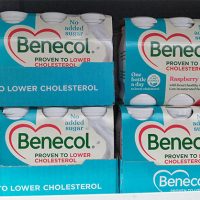
Sometimes I see Benecol, sometimes it’s just the supermarket own-brand version, and sometimes it’s both. Tesco, Lidl, Asda and Aldi all sell their own cholesterol-lowering drinks, and they’re usually a lot cheaper than Benecol.
For a long time I assumed Benecol must be better, otherwise why would people pay more? Then I started looking properly at the labels and realised the supermarket versions can be surprisingly similar.
So that’s what I’m looking at here. Are the supermarket cholesterol-lowering drinks from Tesco, Lidl, Asda and Aldi as good as Benecol, or are you giving something up by choosing the cheaper option?
Along the way I’ll also cover what the research says about how well these drinks work, and where they sit compared with the basics that lower cholesterol too, like diet changes and being more active.
Quick answer: Are supermarket cholesterol-lowering drinks as good as Benecol?
Yes. Tesco, Lidl, Asda and Aldi cholesterol-lowering drinks can be as effective as Benecol because they all provide around 2 g of plant sterols or stanols per bottle, which is the dose shown to lower LDL (“bad”) cholesterol.
Do cholesterol-lowering drinks actually work?
Yes, cholesterol-lowering drinks do work – at least those fortified with plant sterols or plant stanols, such as Benecol and supermarket own-brand versions. These compounds occur naturally in small amounts in plant foods, but in a concentrated dose they block some of the cholesterol absorbed in the gut, so less ends up in the bloodstream.
Studies show that getting around 1.5–3 g a day of plant sterols or stanols can lower LDL (“bad”) cholesterol by about 7–12% when combined with a diet low in saturated fat (as shown in a 2014 meta-analysis and a 2012 EFSA review). So they can definitely help, but they still work best alongside more fibre, more plants and fewer ultra-processed foods.
How do Tesco, Lidl, Asda and Aldi cholesterol drinks compare to Benecol?
Once you know that cholesterol-lowering drinks can work, the obvious next question is whether the cheaper supermarket versions are as good as Benecol. When you line the bottles up and actually read the labels, they turn out to be much more similar than the price would suggest.
They all:
- Use plant sterols or plant stanols as the active ingredient
- Provide around 2 g per bottle – the dose used in studies showing meaningful LDL reductions
- Rely on the same basic mechanism (blocking some of the cholesterol you absorb in the gut)
The main differences are in the type of compound (sterols vs stanols), plus sugar, sweeteners, calories and price.
At a glance: ingredients compared
Here’s how Benecol and the main supermarket cholesterol-lowering drinks look side by side. Ingredients are summarised from current UK labels (always double-check your own bottle, as recipes can change).
| Product | Active ingredient & amount (per bottle) | Key ingredients (summary) |
| Benecol yogurt drink (Blueberry) | Plant stanols, about 2 g per 67.5 g bottle | Yogurt (85%) (Skimmed Milk, Yogurt Cultures), Water, Plant Stanol Ester (Plant Stanols 3%), Lemon Juice, Stabiliser (Pectin), Sweetener (Sucralose), Vitamin B1 |
| Tesco cholesterol-lowering yogurt drink (Strawberry) | Plant sterols, about 2 g per 100 g bottle | Skimmed Milk, Milk Mineral Concentrate, Strawberry Juice from Concentrate (5%), Plant Sterols (3%)(Plant Sterols, Antioxidant (Ascorbyl Palmitate, Tocopherol-Rich Extract)), Flavouring, Maize Starch, Colour (Anthocyanins), Thickener (Locust Bean Gum), Starter Culture, Acidity Regulator (Disodium Citrate, Citric Acid), Sweetener (Sucralose), Bifidobacterium, Milk Proteins |
| Lidl Milbona “Cholesterlow” yogurt drink | Plant sterols, about 2 g per 100 g bottle | 96% Skimmed Milk, 3.6% Plant Sterols Ester*, Sweetener: Sucralose, Starter Cultures (Milk). *Equivalent to 2% Free Plant Sterols. |
| Asda cholesterol-lowering yogurt drink (Strawberry) | Plant sterols, about 2 g per 100 g bottle | Skimmed Milk, Strawberry Juice from Concentrate (5%), Milk Extract, Plant Sterol Ester* (3.4%), Sugar, Flavouring, Maize Starch, Colour (Anthocyanins), Starter Culture including Bifidobacterium (contains Milk), Thickener (Carob Bean Gum), Sweetener (Sucralose), Milk Proteins, *Equivalent to 2% free plant sterol |
| Aldi Brooklea Cholesterol yogurt drink (Original) | Plant sterol esters, about 2 g per 100 g bottle | Low Fat Yogurt (Milk), Water, Plant Sterol Esters (2%), Maize Starch, Fatty Acids, Thickener: Pectins, Sweetener: Sucralose, Colour: Plain Caramel, Lemon Juice Concentrate, Flavouring, Vitamin B1 |
What this table tells us
This comparison makes a few things clear:
- All of these drinks follow the same basic recipe: skimmed milk yogurt, around 2 g of added plant sterols or stanols, plus sucralose to sweeten.
- Benecol (blueberry) is the only one using plant stanols; Tesco, Lidl, Asda and Aldi all use plant sterols, but the amount per bottle is very similar.
- The supermarket drinks add fruit juice (strawberry, for example) and a few extra ingredients like colours and thickeners – but a flavoured Benecol (like blueberry) does something very similar, with fruit puree and sugar as well as stanols and sucralose.
From an ingredients point of view, these flavoured cholesterol-lowering drinks are more alike than different. From a cholesterol perspective, they’re all capable of doing the job. Now let’s look at each one briefly.
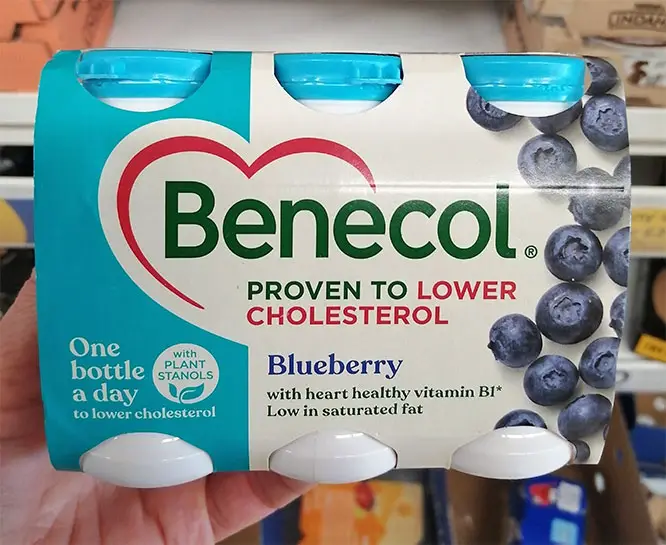
Benecol yogurt drink: how it compares to supermarket drinks
Benecol stands out mainly because it uses plant stanols and comes in a smaller 67.5 g bottle, while the supermarket drinks are all 100 g and use plant sterols. Its recipe is also noticeably shorter and simpler. It’s basically yogurt with added stanols, a little lemon juice, pectin and sucralose.
Compared with Tesco or Asda’s strawberry versions, which include fruit juice, colours and a few extra stabilisers, Benecol does feel a bit “cleaner” in terms of additives.
On the sugar side, Benecol looks higher per 100 g (4.9 g) than the supermarket drinks – Tesco sits at around 4.1 g, Asda at 3.7 g, and Lidl’s Milbona drink is lowest at about 2.4 g per 100 g. But because Benecol’s bottle is smaller, the actual sugar per serving is 3.3 g, so the difference isn’t as noticeable in real life.
Where Benecol doesn’t differ is the sweetener: it uses sucralose, just like all the others. So while the ingredient list is shorter and the bottle is smaller, it’s still very much in the same category – a sweetened, flavoured yogurt shot delivering about 2 g of plant stanols per serving to help lower LDL (“bad”) cholesterol.
Tesco Cholesterol-Lowering Drink
Tesco’s cholesterol-lowering yogurt drink is a popular own-brand alternative to Benecol and comes in several flavours, like strawberry or peach & apricot.
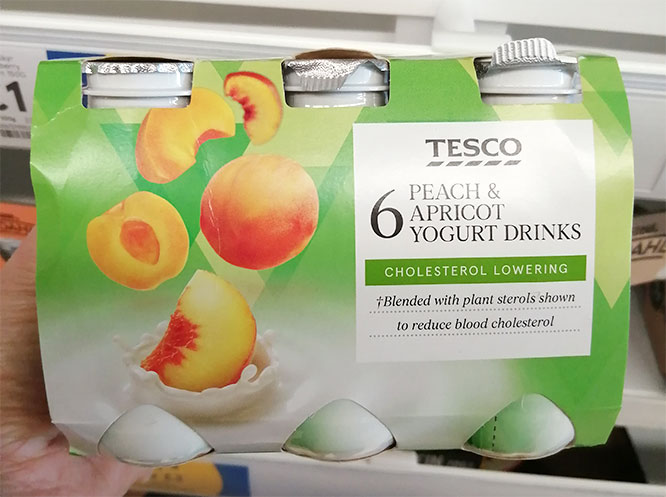
The key active ingredient is plant sterols, and each 100 g bottle provides around 2 g of sterols – the same cholesterol-lowering dose Benecol delivers as plant stanols in its smaller yogurt shots. At this level, sterols and stanols work in a very similar way to lower LDL (“bad”) cholesterol, so the active ingredient isn’t really what sets this drink apart.
What stands out more is everything around it. The larger bottle means the sugar per serving is around 4.1 g – roughly a teaspoon. Not huge, but more than Lidl’s version and a bit more than Asda’s.
The ingredients list is also much longer than Benecol’s. Tesco adds strawberry juice, colour, acidity regulators and a couple of stabilisers. None of this is unusual for a flavoured yogurt drink, but it does make the product feel a bit more “busy” compared with Benecol’s simpler recipe.
Unlike Benecol, Tesco’s drink doesn’t usually include added vitamin B1, and because the bottle is bigger it tends to be a little higher in calories per serving.
If I were choosing a supermarket alternative, this wouldn’t be my first choice. It works, but I’d rather go for something with fewer additives and a shorter ingredients list.
Lidl Milbona ‘Cholesterlow; Cholesterol-Lowering Drink
Lidl also has its own cholesterol-lowering yogurt shots under the Milbona Cholesterlow name, available in several flavours. Each 100 g bottle uses plant sterols, which have the same cholesterol-lowering effect as the plant stanols used in Benecol at this sort of dose. It contains about 3.6% plant sterol esters – roughly 2 g of free plant sterols per shot, similar to the 2 g you get from a Benecol drink.
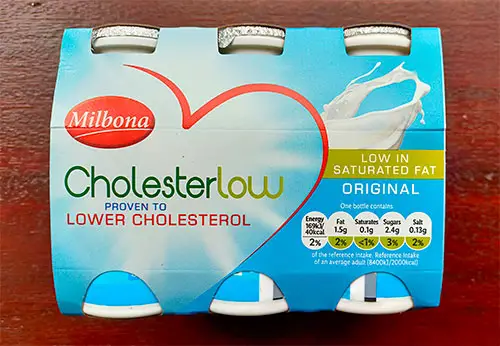
Where this drink really stands out is its sugar content. The Original Cholesterlow flavour has about 2.4 g of sugar per 100 g, and even the strawberry version stays low at roughly 2.6 g per 100 g. That’s noticeably less than Benecol (around 4.3–4.9 g per 100 g, depending on flavour) and also lower than Tesco and Asda’s drinks, making Lidl the lightest option from a sugar perspective.

The ingredient list is fairly simple too: mainly skimmed milk, plant sterol esters, cultures and sucralose as the sweetener, without lots of extra thickeners and colourings.
So yes, Lidl’s cholesterol-lowering drink is as effective as Benecol, and if you’re trying to keep sugar down, it’s often the best supermarket choice.
Asda Cholesterol-Lowering Drink
Asda’s cholesterol-lowering yogurt drink is built on the same idea as the other supermarket versions: a small yogurt shot fortified with plant sterols to help block some of the cholesterol you absorb in the gut. It also comes in different flavours, such as peach & apricot and strawberry.
Each 100 g bottle contains around 3.4% plant sterol ester, which works out at roughly 2 g of free plant sterols – a similar amount of active ingredient to Tesco’s drink and to the 2 g of plant stanols you get in a Benecol shot. So from a cholesterol-lowering point of view, it can do the same job.
When it comes to sugar, the 3.7 g per 100 g puts Asda’s drink somewhere in the middle: lower than Benecol and Tesco, but not as low as Lidl’s Cholesterlow.
The ingredient list is also on the longer side, with extras like colouring and thickeners (such as maize starch) in addition to the usual yogurt base, sterols and sucralose. Nothing unusual for a flavoured yogurt drink, but definitely more going on than in Benecol Original or Lidl’s more stripped-back version.
Overall, Asda’s drink is a solid middle-ground choice: not the simplest and not the lowest in sugar, but a reasonable Benecol alternative that delivers a comparable amount of cholesterol-lowering ingredient to both Tesco’s version and Benecol itself.
Aldi Brooklea Cholesterol Yogurt Drink
Aldi’s Brooklea Cholesterol drinks (Original, Strawberry and Blueberry) work the same way as the other supermarket versions: a low-fat yoghurt drink with added plant sterol esters to help reduce cholesterol absorption.
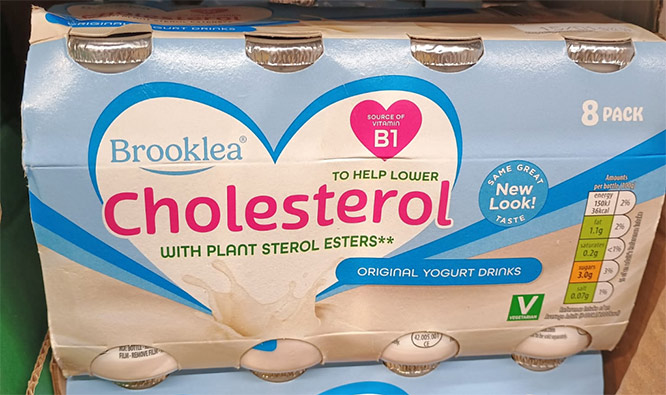
Each 100 g bottle provides roughly 2 g of plant sterols, so it’s in the same cholesterol-lowering range as Tesco, Lidl and Asda (and comparable to Benecol’s dose, just using sterols instead of stanols).
That said, the ingredient list isn’t as simple as Benecol’s. Alongside the yoghurt base and sterols, it includes a few extra ingredients for texture/stability and flavour, and it’s sweetened with sucralose (an artificial sweetener), just like most of the other supermarket drinks.
Overall, it’s a good-value alternative for the sterol dose, but if you’re choosing mainly on the shortest ingredient list, Benecol (especially the simpler versions) still has the edge.
Supermarket drinks vs Benecol: the bottom line
After looking at the labels and the research, the main message is that Tesco, Lidl, Asda and Aldi are genuine alternatives to Benecol. Benecol uses plant stanols, while the supermarket drinks use plant sterols, but at the amounts used in these yogurt shots they work in a very similar way to help lower LDL cholesterol, especially when you’re also eating a diet lower in saturated fat.
The real differences are in the details. Supermarket drinks are almost always cheaper, Lidl’s Cholesterlow range is clearly the lowest in sugar, Aldi’s Brooklea drinks sit not far behind, and Benecol Original has one of the shorter and simpler ingredient lists.
Flavoured versions from any brand tend to have longer labels, with fruit juice, colours, thickeners and so on, so it’s worth checking the back of the pack if you’re trying to keep additives down.
If you’re planning to try one of these and wondering which is the best cholesterol-lowering drink for you, the Original, unflavoured versions are usually your best bet: simpler ingredients, less “extra” stuff and, in Lidl’s case, less sugar as well.
From a cholesterol-lowering point of view, all of these options can still do the job, so the “best” choice really comes down to what matters most to you – price, sugar, ingredients, or skipping sweeteners altogether and focusing on food first.
A note on long-term use
Now that we’ve looked at how these drinks compare, it’s also worth touching on something they all have in common: sucralose. It’s approved as safe, but some newer research makes me unsure about using it every single day, long term.
A few studies suggest that sucralose can change the balance of gut bacteria, and this may affect how the body handles things like glucose and insulin. For example, in one 10-week study, people who took sucralose every day showed shifts in their gut microbes and a higher insulin response compared with those who didn’t.
A recent review also highlighted that artificial sweeteners, including sucralose, may reduce some helpful gut bacteria that support healthy metabolism.
Shorter studies don’t always show these effects, but they only last a week or two, so they can’t tell us what happens with months of daily use.
Because of that, if you want to use these drinks, I’d see them as a short-term support (maybe a few weeks) while also improving your diet. Using them without changing anything else is unlikely to help much, as the research shows they work best alongside a diet lower in saturated fat.
FAQs
Is Benecol good for cholesterol?
Yes. Benecol yogurt drinks are fortified with plant stanols, which help block some of the cholesterol you absorb in the gut. Each bottle contains about 2 g of plant stanols, which sits in the 1.5–3 g daily range that studies have found can lower LDL (“bad”) cholesterol by around 7–12% when your overall diet is lower in saturated fat.
Can you lower cholesterol without these drinks?
Yes. These drinks can help, but they work best alongside diet and lifestyle changes. Increasing fibre (especially oats, beans, lentils, fruit and veg), cutting back on saturated fat and ultra-processed foods, and choosing healthier fats like olive oil, nuts and seeds can have a big impact on LDL cholesterol on their own. Many people can lower cholesterol naturally just by improving their diet and being more active.
Do cholesterol-lowering drinks work without diet changes?
They might give you a small reduction, but the research shows they work far better when your diet is also lower in saturated fat. Using the drinks without changing the rest of your eating habits is unlikely to make a meaningful difference.
How long do cholesterol-lowering drinks take to work?
Most people will see a change in 2–3 weeks, especially if their diet improves at the same time.
What’s the difference between plant sterols and plant stanols?
Plant sterols and plant stanols are very similar. They’re both naturally found in small amounts in plant foods, and they both lower LDL cholesterol by blocking some of the cholesterol absorbed in the gut. Benecol uses stanols, while supermarket drinks use sterols, but at the amounts in these products they work in a very similar way.
Final thoughts
So yes, the supermarket cholesterol-lowering drinks hold up well against Benecol. They work in a very similar way, and for most people the differences come down to sugar, ingredients and price rather than effectiveness.
But they’re optional. If you do use them, let them support – not replace – the things that make the biggest difference: your overall diet, your lifestyle and the guidance of your healthcare professional.
My own view is that these drinks are helpful for short-term support, especially if you’re making changes to your diet at the same time. But you don’t need them to lower cholesterol. A diet richer in fibre, more plants, fewer ultra-processed foods and less saturated fat can make a huge difference on its own.
So if you want something convenient and affordable, the supermarket drinks are perfectly good options. And if you’d rather skip the sweeteners and focus on whole foods, that’s a completely valid (and often more sustainable) approach too.

Petra Nakashian (previously Kravos) has been writing about health and healthy living for over 10 years. She covers nutrition, natural health, and everyday wellness topics, with a focus on clear, practical advice you can actually use. Petra enjoys digging into health books, studies, and reputable research to check health claims, because there’s a lot of advice online that sounds convincing but isn’t accurate.