Recently updated on March 3rd, 2026 at 9:54 pm
Actimel has been a go-to yoghurt drink for years, and it’s no surprise people are curious about its real health benefits. If you’ve ever wondered, “Does Actimel actually do anything, or is it mostly marketing?”, this article breaks it all down. We’ll look at what it may help with, and the downsides that are worth knowing before you make it a daily habit.
Quick answer
Is Actimel good for you? For most people, yes, it can be a simple, convenient yoghurt drink with live cultures and added vitamins. It might help digestion for some people, but it’s not a miracle product, and it may not suit you if you’re sensitive to dairy or sweeteners.
This article is for general information, not medical advice.
Actimel at a glance (30 seconds)
Actimel is a small yoghurt drink with live cultures and added vitamins. People mainly drink it to support digestion and ease things like bloating, or because they want an easy “daily yoghurt” habit.
What you can realistically expect: if it helps, it’s usually a mild, steady benefit (less bloating for some people, a bit more regularity). If you feel nothing after a few weeks, it’s probably not worth continuing.
When it’s worth trying: you like yoghurt, you want something convenient, and you’re curious whether a daily probiotic-style drink suits you.
When you might skip it: dairy doesn’t agree with you, or you prefer to avoid added sugar or sweeteners (different Actimel versions use one or the other).
The main Actimel versions (and why it matters)
As you’ve probably already noticed, there are quite a few different versions of Actimel. The main difference is simple: some are sweetened with added sugar, and others are 0% added sugar but use sweeteners instead. There’s also a more “fortified” range with extra vitamin D.
Core range (Original and flavours like Strawberry)
This is the classic Actimel. It contains added sugar, usually listed as sugar or liquid sugar and dextrose, so it tastes more like a traditional sweet yoghurt drink. If you enjoy the taste and you’re not trying to cut down on added sugar, this is the straightforward option.
0% Fat 0% Added Sugars range
This version has no added sugar and is much lower in calories, but it uses sweeteners instead, usually sucralose and acesulfame K. It can be a good fit if you want a lighter option, but if sweeteners don’t agree with you, it may not be the best choice.
Actimel+ Triple Action (higher vitamin D)
This is the more “boosted” range. It’s aimed at people who want extra nutrients, especially vitamin D, but it isn’t automatically lower in sugar, so it’s still worth checking the label. Think of it as Actimel with added extras, rather than a completely different drink.
Also worth knowing: Actimel also has a Kids range (for example Strawberry & Banana). It’s still a yoghurt drink with the same L. casei culture and vitamins, but the ingredients and sugar can be different from the adult ranges, so it’s worth checking the label if you’re buying it for a child.
What’s in Actimel? Ingredients that matter
Actimel ingredients can look a bit different depending on the bottle you pick up. The main choice is simple: added sugar, or no added sugar but sweeteners.
Core Original (sweetened with added sugars)
Ingredients (Core Original): Yogurt (Milk), Skimmed Milk, Sugar/Liquid Sugar, Dextrose, Milk Mineral Concentrate, Lactobacillus casei (L. casei Danone®), Vitamins (D and B6).
What stands out: This is the classic version, but it does contain added sugar, including dextrose which is just another form of sugar. It’s closer to a sweet yoghurt drink than a “clean” fermented food, and if the goal is mainly good bacteria, plain yoghurt or kefir is usually a cleaner option.
The 0% Original (no added sugar, but sweeteners)
Ingredients (0% Original): Yogurt (Milk), Water, Skimmed Milk, Stabiliser (Pectin), Milk Mineral Concentrate, Sweeteners (Sucralose, Acesulfame K), Natural Flavourings, Lactobacillus casei (L. casei Danone®), Vitamins (B6, D).
What stands out: You’re not getting added sugar here, but you are getting sweeteners instead (sucralose and acesulfame K). Some people prefer this version because it’s much lighter and lower in calories, but if sweeteners tend to give you headaches, cravings, or a funny stomach, it might not be the best fit.
It’s also worth knowing the research on sweeteners is still evolving. The WHO advises not using non-sugar sweeteners as a weight-control strategy, and studies looking at things like appetite, blood sugar and the gut microbiome show mixed results depending on the sweetener and the person.
Flavoured Actimel – means a longer ingredients list
Once you move from Core Original (the classic one with added sugar) to the flavoured versions, you’ll usually see extra ingredients added for taste and texture.
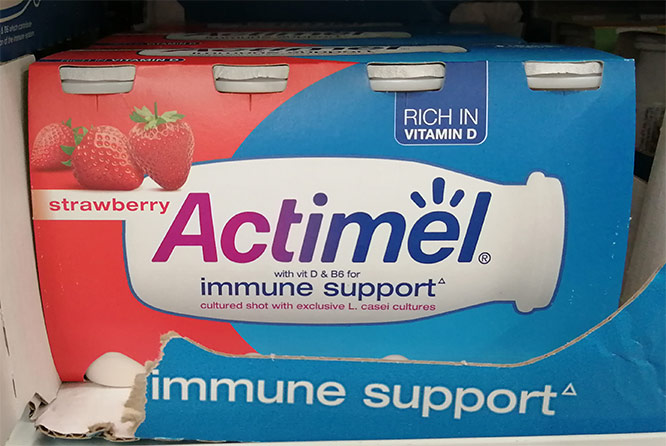
For example, Strawberry Actimel (Core range) includes strawberry purée (2.1%), oligofructose (fibre), modified starch, and acidity regulators (citric acid, sodium citrate). It also lists “flavourings”, which is a broad label term. It doesn’t tell you whether they’re natural or not, it just means flavour has been added.
Why it matters: Flavoured versions aren’t automatically “bad”, but they are usually more processed, and “flavourings” doesn’t tell you exactly what’s been used.
Most people will be totally fine with it, but if you’re sensitive (for example you notice certain foods trigger headaches, cravings, or a weird stomach), going simpler can make life easier.
Bottom line: Actimel is still a fairly processed probiotic drink. Yes, it contains live cultures and added vitamins, but you’re basically choosing between added sugar (in the classic range) or sweeteners (in the 0% range), and neither option is something I’d call “healthy” in the same way as plain yoghurt or kefir.
Actimel nutrition: quick comparison
If the ingredients section left you thinking “okay, but how different are these bottles really?”, this is where you get the answer. Below is a simple comparison of the main versions (values are per 100g, which is usually close to one small bottle, but always check your label).
Nutrition comparison (per 100g)
| Core Original | Core Strawberry | 0% Original (0% Fat, 0% Added Sugars) | Triple Action (Blueberry & Blackberry) | |
| Calories (kcal) | 72 | 72 | 27 | 73 |
| Carbohydrate (g) | 11 | 11 | 3.0 | 11 |
| of which sugars (g) | 11 | 11 | 3.0 | 11 |
| Fat (g) | 1.5 | 1.4 | 0.1 | 1.4 |
| Saturated fat (g) | 1.0 | 1.0 | 0 | 1.0 |
| Protein (g) | 3.0 | 2.8 | 2.7 | 2.8 |
| Fibre (g) | 0 | 1.0 | 0.2 | 1.0 |
| Vitamin D | 1.67µg (33% RI) | 1.67µg (33% RI) | 1.67µg (33% RI) | 5µg (100% RI) |
| Vitamin B6 | 0.21mg (15% RI) | 0.21mg (15% RI) | 0.21mg (15% RI) | 0.21mg (15% RI) |
| Calcium | 120mg (15% RI) | 120mg (15% RI) | 120mg (15% RI) | 120mg (15% RI) |
*RI: Reference intake of an average adult (8400 kJ/2000 kcal)
Key takeaways
- Core Original and Core Strawberry are basically the same deal. Same calories and carbs, and pretty much all of those carbs are sugar (11g per 100g).
- The 0% version is much lower in calories and carbs, but that “lighter” feel comes from swapping added sugar for sweeteners.
- Calcium and vitamin B6 don’t really change across these versions. If you’re choosing between bottles, those aren’t the deciding factors.
- “0% added sugars” doesn’t mean sugar-free. There’s still sugar in there (3g per 100g) — it’s just naturally occurring milk sugar.
Triple Action isn’t a lower-sugar choice. It’s similar to the classic range for calories and sugar, it just gives you a bigger vitamin D boost (add extras like vitamin C and magnesium).
Potential benefits (what it may help with)
So, what can Actimel realistically do for you? That’s where the “benefits” conversation gets a bit more complicated, because probiotics don’t work like painkillers. With probiotics, it’s rarely a guaranteed effect. It’s more a “might help, might do nothing” situation, and a lot depends on your own gut and what you’re already eating.
May support normal immune function
Actimel may support normal immune function in two main ways.
First, it contains vitamin D and vitamin B6, and both have authorised health claims for contributing to the normal function of the immune system.
Second, it gives you a daily dose of a probiotic strain (L. casei DN-114001). Probiotics can support your immune system by helping your gut stay in better shape, because a lot of your immune system “lives” in and around the gut. In simple terms, if your gut barrier and gut bacteria are doing well, your immune system often works more smoothly too.
In fact, L. casei DN-114001 has been tested in a few human studies. In one study in students under exam stress, the probiotic drink helped prevent the usual drop in some infection-fighting white blood cells during the stressful period.
Another trial in adults over 70 found a stronger flu vaccine response (higher flu antibodies after the jab). And a larger study in older adults found that when people did catch a common infection, it tended to last fewer days on average, meaning they recovered a bit quicker.
It’s not a guarantee you’ll get sick less, but it does help explain why some people feel a small benefit, while others don’t notice much at all.
Can help you top up vitamin D
This is one of the clearest benefits on the label. Most Actimel bottles give you about 33% of your daily reference intake of vitamin D (per 100g), and the Triple Action range goes up to 100%.
Vitamin D matters because it helps your body manage calcium and phosphate, which supports bones, teeth and muscles, and it also plays a role in normal immune function.
The NHS also points out that many people in the UK don’t get enough vitamin D, especially in autumn and winter. Low levels over time can contribute to bone pain and muscle weakness (and rickets in children).
May help with bloating and being more regular (for some people)
Some people find probiotic drinks like Actimel help with everyday digestive niggles, mainly bloating, wind, and being more regular. It’s not a guaranteed effect, but it’s one of the more realistic reasons to try it.
The NHS is pretty balanced on probiotics. It says there’s some evidence they may help ease some IBS symptoms, but also that there isn’t strong evidence behind a lot of probiotic “health claims” in general. So it’s worth trying, but it’s not a sure thing.
If you’re trying Actimel (or any probiotic) for IBS-type symptoms, the simplest approach is a short trial. NHS Inform suggests taking a probiotic daily for at least 4 weeks, then deciding if it’s genuinely helped.
If nothing changes after that, it’s probably not worth continuing.
May reduce the risk of antibiotic-associated diarrhoea (in some situations)
Actimel contains the probiotic strain L. casei DN-114001, and this strain has been looked at for antibiotic-associated diarrhoea.
An evidence-based practical guide that reviews a lot of probiotic research lists L. casei DN-114001 as one of the strains with strong evidence for helping prevent antibiotic-associated diarrhoea.
But it’s not a guaranteed win. A large UK hospital trial using DN-114001 didn’t find a clear benefit in older patients, which suggests it can really depend on the person and the situation.
So the fairest takeaway is: it may help some people, especially if antibiotics usually upset their stomach, but it’s not something you can rely on 100%.
Other potential benefits (mostly studies in children)
A couple of studies on the same probiotic strain used in Actimel have looked at kids, so I’m including them for completeness.
One important thing to keep in mind though: the drinks used in studies aren’t always identical to the exact Actimel you buy today. Actimel also comes with “extras” depending on the version, like added sugar in the classic range or sweeteners in the 0% range. That could matter, so we can’t assume the results will carry over perfectly for everyone.
With that said, here’s what the research on this strain has found in young children:
- May help reduce episodes of acute diarrhoea: In one study, a daily dairy drink containing L. casei DN-114001 was linked with fewer diarrhoea episodes in children aged 6–24 months compared with standard yoghurt.
- May slightly reduce everyday illnesses in nursery-age children: In the DRINK study, children aged 3–6 who had a daily drink with L. casei DN-114001 had a lower overall rate of common infections (mostly tummy bugs).
If this is something you’re looking at for your child, probiotics can be a nice extra, but for diarrhoea the basics matter most (fluids and oral rehydration). And if symptoms are severe or your child shows signs of dehydration, follow official advice.
Actimel and IBS: is it worth trying?
If you have IBS, Actimel might be worth a short trial, but it’s not a sure thing. Probiotics are very individual. One person feels better, another feels nothing, and someone else feels worse.
A simple way to try Actimel (without overthinking it)
If you want to test it, do it like this:
- Pick one product and stick with it (don’t mix multiple probiotic drinks/supplements at the same time).
- Have it daily for at least 4 weeks, then decide if it’s genuinely helping.
- Keep a quick note of what you actually care about: bloating, pain, stool changes, and how often you’re rushing to the toilet.
- If symptoms clearly get worse, stop. That’s still a useful result.
What you might notice (if it helps)
If Actimel helps, it tends to be small, practical improvements, like feeling less bloated, being a bit more regular, or having fewer “off” days. It’s not usually dramatic.
Also worth knowing: some people get extra gas or bloating for the first few days when they start probiotics. If it settles quickly, fine. If it ramps up and stays bad, it’s probably not for you.
When Actimel is more likely to be a bad fit
Actimel is dairy-based, so if milk normally triggers your IBS, it may not be the best choice. And if you know sweeteners mess with your digestion, the 0% added sugars version could be a problem too.
One more honest note: not every expert group is positive on probiotics for IBS. The American College of Gastroenterology guideline suggests against probiotics for overall IBS symptoms because the evidence is very low quality.
Weight loss: is Actimel helpful?
Actimel isn’t a weight-loss drink. The only time it really helps is if you use it as a swap for something more calorie-dense (biscuits, chocolate, sugary snacks). If you just add it on top of what you already eat, it won’t make much difference.
If weight loss is your goal, the version matters
The classic bottles are higher in sugar and calories. The 0% version is much lower in calories, but it comes with sweeteners, which some people prefer to avoid.
What we know about Actimel’s strain and weight loss
There aren’t good human studies showing Actimel’s specific strain (L. casei DN-114001) helps with weight loss. Most research around this strain focuses on immunity and infections rather than body weight.
Other probiotic strains and weight loss
Some probiotics do have human studies showing a small effect on things like belly fat or weight-related measures – but it depends on the strain, dose, and time, and the changes are usually modest. For example, Lactobacillus gasseri has been linked with reduced abdominal fat in a randomised trial, and meta-analyses tend to find small average improvements across studies.
Cholesterol: what Actimel can (and can’t) do
Actimel is not really a cholesterol-lowering product, and there is not much solid human evidence that its specific strain (L. casei DN-114001) meaningfully lowers cholesterol on its own.
That said, probiotics in general may have a small cholesterol benefit in some people. Meta-analyses of clinical trials have found modest average reductions in total cholesterol and LDL, but results vary a lot by strain, dose, and the person.
If cholesterol is the main goal, you’ll usually get more noticeable results from the proven basics and specific cholesterol-lowering foods (like plant sterols/stanols and oat beta-glucan) than from Actimel.
Side effects and who should avoid Actimel
Most people tolerate Actimel just fine. If you do get side effects, they’re usually mild and tend to happen when you first start drinking it regularly.
Common side effects (usually mild)
- Bloating or extra gas for the first few days (your gut can take a bit of time to adjust)
- Changes in bowel movements (a bit looser or more frequent, sometimes the opposite)
- If you choose the 0% version: some people react to sweeteners with things like headaches or digestive upset
If anything feels clearly worse after a week or so, it’s a good sign it’s not the right product for you.
Who should be cautious or skip it
- Milk allergy: avoid (this one’s non-negotiable)
- Lactose intolerance or dairy sensitivity: you might be fine, or it might flare symptoms, so it’s a “try carefully” situation
- Sensitive to sweeteners: the 0% added sugars version may not suit you
- Weakened immune system or serious illness: check with your doctor before using probiotic products regularly (especially if you’ve been advised to avoid live bacteria foods)
And as always, if you ever get severe symptoms (strong abdominal pain, blood in stool, signs of dehydration, high fever), stop and get medical advice rather than trying to “push through”.
How to take Actimel (timing and amount)
What matters most is consistency. If you’re going to try it, having it regularly beats stressing about the “perfect” time.
Best time to take it
Any time that fits your routine. Actimel itself says it can be taken at any time of day, and suggests breakfast simply because it’s easy to remember.
How many per day
Start with one a day and see how you feel. Actimel recommends no more than 2 a day as part of a healthy diet.
How long to try it before deciding
Give it a fair run, then decide based on what you actually notice. For IBS-style goals, NHS Inform suggests trying a probiotic product for at least 4 weeks before judging it.
FAQs
Is Actimel good for constipation?
It might help some people, but it’s not a reliable constipation fix. If constipation is your main issue, the basics (fluids, fibre, movement) usually make a bigger difference than any probiotic drink.
Can you drink Actimel when pregnant?
For most people, yes. Probiotics like Lactobacillus and Bifidobacterium have generally looked safe in pregnancy in research, but if you’ve got a high-risk pregnancy or a weakened immune system, it’s worth checking with your midwife/GP first.
Can kids drink Actimel?
Actimel says it’s suitable for the family from age 3 upwards. For under-3s, they say it’s not formulated for their specific nutritional needs.
Can you drink Actimel every day?
Yes, if it suits you. Just keep it sensible. Actimel recommends no more than 2 a day as part of a healthy diet.
If you want a daily probiotic, here’s the takeaway
If you’re looking for a daily probiotic, Actimel wouldn’t be my first choice. Even though it has a useful strain and added vitamins, it’s still quite processed, and you’re basically choosing between added sugar (classic versions) or artificial sweeteners (the 0% version). Neither feels like a great “every single day” option.
Sweeteners in particular are still being researched, and there are enough question marks around long-term use that I wouldn’t treat them as a health upgrade. The WHO even advises against using non-sugar sweeteners for longer-term weight control.
If the goal is “good bacteria every day”, cleaner options like plain live yoghurt, kefir, and other fermented foods are usually a better bet. You get the benefits without the extra sugar or sweeteners, and you can always add fruit yourself if you want it sweeter.
More articles about Actimel:
Yakult vs Actimel
Benecol vs Actimel

Petra Nakashian (previously Kravos) has been writing about health and healthy living for over 10 years. She covers nutrition, natural health, and everyday wellness topics, with a focus on clear, practical advice you can actually use. Petra enjoys digging into health books, studies, and reputable research to check health claims, because there’s a lot of advice online that sounds convincing but isn’t accurate.