
Recently updated on January 22nd, 2026 at 11:07 am

A lot of people end up with both turmeric and magnesium at home and naturally ask: is it actually safe to take them together?
For most healthy adults, research hasn’t found any problem with combining them – they don’t clash or cancel each other out, and it’s generally safe to use them on the same day or even at the same time.
The main things to watch out for are how your body reacts (both can irritate the stomach in higher doses) and whether your medications or health conditions make either supplement (or the combination) a bad fit for you.
Here’s a simple, clear look at how they work, who can safely take them together, and when it’s better to be more cautious.
What Turmeric and Magnesium Actually Do in Your Body
Before looking at why people combine them, it helps to understand what each supplement does on its own.
Magnesium at a glance
Magnesium is involved in more than 300 biochemical reactions in your body – everything from how your nerves fire to how your muscles relax, how your heart beats, and how your blood sugar is regulated.
A lot of people take it because they struggle with sleep, feel tense or “wired,” get cramps, deal with migraines, or get an annoying twitchy eyelid now and then (although it’s not always magnesium-related). It’s one of those minerals where even a small deficiency can make you feel off.
Turmeric & curcumin at a glance
Turmeric is the spice, but curcumin is the part inside it that does most of the work. It makes up only about 1–7% of the root, which is why supplements often focus on curcumin extracts rather than the spice itself.
Curcumin is widely studied for its anti-inflammatory and antioxidant effects, and research suggests it may help with joint pain, metabolic health, digestion and even mood. It’s also being researched alongside standard treatment in some long-term conditions, but it shouldn’t be used as a stand-alone treatment for serious illnesses like cancer.
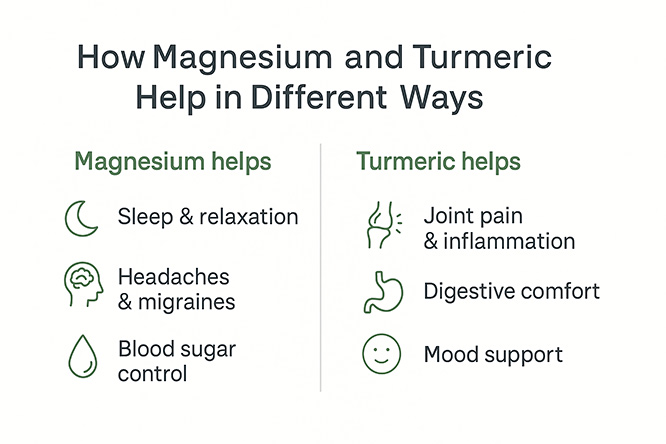
Both supplements do quite different things – which is exactly why many people end up using them side by side.
Potential Benefits of Taking Them Together
People often pair turmeric and magnesium because they support the body in different but complementary ways. Here’s where the combination might make a noticeable difference.
Joint pain, stiffness and chronic inflammation
If you live with ongoing aches or stiff joints, magnesium and turmeric are a popular combination to try.
Research suggests that higher magnesium intake is linked with a lower risk of chronic pain, and that supplements can support muscle strength, recovery and inflammation.
Turmeric — or more specifically curcumin — has been shown in clinical trials on osteoarthritis to reduce joint pain and improve daily function.
Used together, they won’t replace proper medical treatment, but they can be a gentle add-on for some people as part of a wider pain-management plan.
Migraines, headaches and muscle tension
Magnesium has the strongest evidence here. Several clinical trials and reviews suggest it can help reduce how often migraines happen and how intense they are, which is why it’s often recommended as a preventive supplement – especially if you’re low in magnesium. It may also help with tension-type headaches by relaxing tight muscles in the neck and shoulders.
Curcumin is newer in this area, but early studies and meta-analyses suggest it can reduce migraine severity and may shorten attacks, particularly in more absorbable forms like nano-curcumin. The research is still limited, so it’s best seen as a possible add-on rather than a main treatment.
It’s important to say this clearly: neither supplement replaces prescribed migraine medication, but together they may offer extra support for some people under medical guidance.
Sleep, stress and mood support
Magnesium is well known for its calming effect. It helps your muscles relax and supports the nervous system, and studies suggest it can improve sleep quality and ease mild anxiety or restlessness, especially if you’re low in magnesium.
Turmeric, through its active compound curcumin, may also support mood. Human studies have found that curcumin, taken alongside usual treatment, can reduce depressive symptoms in some people.
Together, they can feel like a nice balance – magnesium for physical relaxation, turmeric for a steadier, calmer mood.
Blood sugar, blood pressure and metabolic health
This is where turmeric and magnesium quietly support the “behind the scenes” work in your body. By metabolic health, I simply mean how well you manage blood sugar, blood pressure, cholesterol and inflammation.
Magnesium helps your body handle sugar more smoothly by making it easier for insulin to move sugar from your blood into your cells. In studies of people with raised blood sugar or type 2 diabetes, magnesium supplements have led to small improvements in blood sugar control.
Curcumin helps more on the inflammation side. In people who are overweight, have type 2 diabetes or fatty liver, curcumin supplements have led to small improvements in inflammation, some liver tests and even waist size.
On their own, these changes are modest, but together with better food choices, movement and sleep, magnesium and turmeric can be useful extra tools.

Is It Safe to Take Turmeric and Magnesium at the Same Time?
For most healthy adults, it is considered safe to take turmeric and magnesium at the same time, especially if you keep to sensible doses and take them with food. There’s no strong evidence that they react badly with each other – what really matters is how much you use, what medicines you’re on and whether you have any underlying health conditions.
Do they interact with each other?
Interaction checkers that look at magnesium (including glycinate) and turmeric don’t list any direct interactions between the two.
That doesn’t mean side effects are impossible, but if problems happen they’re usually due to:
- taking too much of one supplement, or
- the way each supplement affects your medications or an existing condition, not because they clash with each other.
Magnesium: safe dose and side effects
For adults, typical daily needs from food and supplements together are roughly:
- 310–320 mg a day for most women
- 400–420 mg a day for most men
For supplements, most health bodies suggest no more than 350 mg a day from pills or powders unless your doctor tells you otherwise. That’s because higher doses are much more likely to cause problems.
Possible side effects of magnesium supplements
Magnesium can cause:
- loose stools or diarrhoea
- cramping
- nausea
These issues are more common with forms like magnesium oxide. Forms such as magnesium glycinate are often easier on the stomach, but the same 350 mg limit still applies.
If you have kidney problems, you need extra care, because your body may not clear magnesium properly and levels can build up.
Turmeric: safe dose and side effects
In studies on turmeric supplements, extracts providing around 500–2,000 mg of curcumin a day are common, usually split into two or three doses.
These amounts are much higher than you’d ever get from food, so it’s important to follow the dose on the label and not assume “more is better”.
Possible side effects of turmeric supplements
- indigestion or reflux
- bloating or nausea
- diarrhoea
And although it’s rare, there have been case reports of liver injury linked to high-dose turmeric or “high-absorption” curcumin products, especially in people with existing liver issues or when they’re taken for long periods. Turmeric used in normal cooking amounts isn’t part of this concern.
Side effects when you take them together
When you combine turmeric and magnesium, the most common issue is an upset stomach. Both supplements can affect your gut, so taking them together (especially at higher doses or on an empty stomach) can make bloating, nausea, indigestion, reflux or looser stools and diarrhoea more likely.
If that happens, a few simple tweaks usually help:
- Take them with food, not on an empty stomach
- Lower the dose or start with just one supplement and add the other later
- Try spacing them out (for example, magnesium in the evening, turmeric with lunch)
- If magnesium is the main issue, switching to a gentler form like magnesium glycinate can sometimes reduce diarrhoea or cramping
If side effects are severe, don’t settle down after a few days, or you notice worrying symptoms such as strong abdominal pain, very dark urine, yellowing of the skin or eyes, or blood in your stool, stop the supplements and speak to a doctor or pharmacist.
Who should be extra careful?
It’s especially important to speak to your doctor or pharmacist before combining turmeric and magnesium if you:
- Take blood thinners or medicines that affect clotting (e.g. warfarin, DOACs, aspirin, clopidogrel).
Turmeric can make blood-thinning stronger and may raise bleeding risk. - Take strong medicines for diabetes, blood pressure, the heart, cancer or mood
Turmeric can change how some drugs are absorbed or how hard they work; magnesium can interfere with absorption of a few medicines if taken at the same time. - Use antibiotics, thyroid tablets or osteoporosis medicines
Magnesium can “stick” to some of these in the gut and stop them being absorbed. You’re usually told to separate magnesium by at least 2 hours on either side. - Have kidney disease
Your kidneys may struggle to clear extra magnesium, which can become dangerous. - Have gallstones, bile-duct problems, stomach ulcers, severe reflux or liver disease
Turmeric supplements can worsen some of these issues and, rarely, stress the liver. - Are pregnant or breastfeeding
Turmeric as a spice in food is widely seen as safe, but turmeric/curcumin supplements are much stronger and haven’t been well studied in pregnancy. Magnesium from food is fine; magnesium supplements should stay within the usual 350 mg/day cap unless your doctor says otherwise.
If you’re on regular prescription meds or have a long-term condition, a quick check with a health professional is always worth it before you start both supplements together.
FAQs
What’s better – turmeric or magnesium?
Turmeric and magnesium aren’t really “better” or “worse” than each other – they just do different things. Magnesium is more about nerves, muscles, sleep, headaches and blood sugar, while turmeric (through curcumin) is more focused on inflammation, joint pain and possibly mood and longer-term metabolic health.
Which one is more useful for you depends on what you’re trying to improve and what your doctor has recommended. Many people use both for different reasons, so if you’re not sure where to start, it’s best to speak to a health professional who knows your medical history.
Can you take turmeric with magnesium glycinate?
In most cases, yes. There are no known direct interactions between turmeric and magnesium glycinate, and glycinate is often one of the better-tolerated forms of magnesium for people who struggle with loose stools or cramping.
The same general rules still apply: keep magnesium within a safe daily dose, follow the turmeric label, and speak to a professional if you’re on medication or have ongoing health problems.
Can I take them at the same time or should I separate doses?
Most people can take turmeric and magnesium at the same time, ideally with a meal. If you’re using magnesium to support sleep, taking it in the evening often makes sense, while turmeric can go with any main meal – some people prefer earlier in the day if it tends to trigger reflux at bedtime.
If you notice more indigestion or looser stools when you combine them, you can either lower the dose of one supplement or separate them. For example, take turmeric with lunch and magnesium in the evening.
If you take medicines that magnesium can interfere with (like some antibiotics, thyroid tablets or osteoporosis drugs), the timing for those medicines should come first and magnesium needs to be kept a couple of hours away.
Can magnesium and turmeric help you lose weight?
They’re not weight-loss pills, but they may play a small supporting role. Magnesium can help your body handle blood sugar better, which can make it easier to manage cravings and energy. Curcumin has been shown in some studies to slightly reduce waist size and markers of inflammation in people who are overweight or have type 2 diabetes.
On their own, the changes are usually modest. Think of them as helpers alongside the basics: what you eat, how much you move, your sleep and stress levels.
Does turmeric contain magnesium?
Yes, turmeric does contain some magnesium – but only a tiny amount. You’d need to eat far more turmeric than is realistic in normal cooking to make a real difference to your magnesium intake.
If you’re low in magnesium, it makes more sense to focus on magnesium-rich foods (like nuts, seeds, beans and wholegrains) and, if needed, a supplement, rather than relying on turmeric for that.
More magnesium articles you might find helpful:
Magnesium & Vitamin C: Benefits and Why You Should Take them Together
Can you take magnesium and melatonin together?
Best Magnesium for Sleep and Anxiety: What Actually Helps
Magnesium and Ashwagandha: Benefits, Side Effects & More

Petra Nakashian (previously Kravos) has been writing about health and healthy living for over 10 years. She covers nutrition, natural health, and everyday wellness topics, with a focus on clear, practical advice you can actually use. Petra enjoys digging into health books, studies, and reputable research to check health claims, because there’s a lot of advice online that sounds convincing but isn’t accurate.

