
Recently updated on July 23rd, 2026 at 8:27 pm

Waking up with a painful leg cramp is horrible. One minute you’re asleep, and the next you’re grabbing your calf, trying to stretch it out and wondering what on earth caused it.
Magnesium is one of the first things people recommend for muscle cramps, especially leg cramps at night, and it makes sense. It plays a role in normal muscle function, and not getting enough may make cramps more likely for some people.
But it’s not quite as simple as “muscle cramps mean you need magnesium.” Cramps can happen for lots of reasons, and the research on magnesium is actually mixed. Some people swear it helps, while others notice no difference at all.
So in this post, I’ll look at the best type of magnesium for muscle cramps, with a focus on leg cramps and night cramps, how much you might need, when to take it, and why magnesium may not always be the missing piece.
Disclaimer: Some links in this section are affiliate links. If you buy through them, I may earn a small commission at no extra cost to you. As an Amazon Associate I earn from qualifying purchases.
Best magnesium for muscle cramps: what to choose first
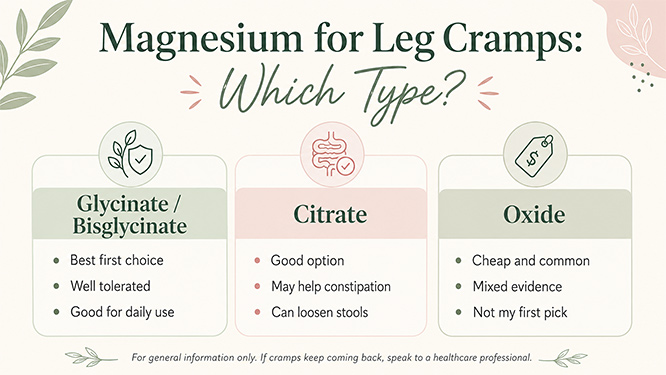
Magnesium glycinate or bisglycinate is usually the best type of magnesium to try first for muscle cramps because it is well tolerated and easy to take regularly.
Magnesium citrate is another good option, especially if constipation is also an issue. But magnesium does not work for everyone, because muscle cramps are not always caused by low magnesium.
Why magnesium gets linked to muscle cramps
Magnesium is often linked to muscle cramps because it helps your muscles and nerves work properly.
When a muscle cramps, it suddenly tightens and doesn’t relax as it should. Magnesium is one of the minerals involved in that relax-and-contract process, so if your intake is low, your muscles may become more likely to twitch, tighten or cramp.
It also works alongside other important minerals, including calcium, potassium and sodium. These all help control muscle movement and nerve signals. If that balance is off, your muscles may become more “irritable”, which can make cramps more likely.
This is why magnesium is one of the first supplements people think of when they get night leg cramps. It makes sense, especially if someone does not eat many magnesium-rich foods or has other signs they may not be getting enough, such as muscle twitching, fatigue, weakness, numbness, tingling or loss of appetite.
What the research says about magnesium and muscle cramps
This is where things get a bit less straightforward. Magnesium is commonly recommended for leg cramps, but the research is mixed. Some studies show little or no benefit, while others suggest it may help in certain situations.
The evidence for night leg cramps is not strong
For ordinary night leg cramps in adults, magnesium has not performed that well in research.
A 2020 Cochrane review looked at magnesium for muscle cramps and found that it is unlikely to make a meaningful difference for older adults. So, for this group at least, magnesium does not look like a reliable way to prevent cramps.
A 2017 study in JAMA Internal Medicine also found that magnesium oxide was not much better than a placebo for night leg cramps. Both groups improved, which shows how tricky this topic is.
This does not mean magnesium never helps anyone. But it does mean we need to be honest: it is not a guaranteed fix for leg cramps.
Pregnancy studies are mixed
The pregnancy research is a bit more mixed.
A study on magnesium bisglycinate in pregnancy found that it helped reduce both the frequency and intensity of pregnancy-related leg cramps. An older 1995 study also found that oral magnesium reduced leg cramp distress in pregnancy.
But not all studies have found the same. A 2020 pregnancy trial using 300 mg of magnesium citrate a day for 4 weeks found no clear difference compared with placebo.
A 2021 meta-analysis also concluded that oral magnesium was not clearly effective for pregnancy leg cramps overall.
So, pregnancy is one area where magnesium may help some women, but the evidence is still not strong enough to call it a guaranteed solution. And because pregnancy is different, it’s always best to check with a midwife or doctor before adding a supplement.
Why studies don’t prove one form is best
The tricky thing is that magnesium studies have not all used the same form.
Some used magnesium oxide, including the 2017 study on night leg cramps. Others used magnesium citrate. Some pregnancy studies used magnesium bisglycinate or other forms.
This makes it hard to say that one type of magnesium is definitely “the best” based only on cramp studies. The research does not give us one clear winner.
So the best approach is to look at the research, but also think practically. Which type is easy to take regularly? Which one is less likely to upset your stomach? And which one makes the most sense for your situation?
Why short studies may not tell the full story
Some magnesium studies for leg cramps lasted only a few weeks. For example, some were around 3 to 4 weeks, while others were closer to 6 weeks.
That may be enough time for some people to notice a difference. But it may not be long enough for everyone, especially if someone has had low magnesium intake for a long time.
Magnesium levels in the body can take time to rebuild. A review on magnesium status notes that it took about 3 months to normalise a 20% depletion of body magnesium stores.
So if a study only lasts 4 weeks and finds no clear benefit, that does not always prove magnesium would never help. But we also need to be careful. It does not prove magnesium would work if people took it for longer either.
It just means the research may not give us the full picture, especially for people who are starting with low magnesium levels.
So, with all that in mind, the question is not “which magnesium is proven to cure leg cramps?” because the research does not show that. The better question is: which type makes the most sense to try first?
A closer look at the best magnesium options
Since the research does not give us one clear winner, the most sensible approach is to choose a form that is easy to tolerate and realistic to take regularly.
Magnesium glycinate or bisglycinate
Magnesium glycinate or magnesium bisglycinate is usually the best place to start if you want to try magnesium for muscle cramps. They are very similar forms, and the names are often used almost interchangeably.
Glycinate is generally well tolerated and less likely to cause loose stools than some other forms, such as magnesium citrate. That matters because if a supplement upsets your stomach, you are less likely to keep taking it.
It is also a simple option for daily use, especially if your cramps happen at night and you want something you can take regularly in the evening.
There is also some positive research behind this form, although mainly in pregnancy. One study found that magnesium bisglycinate helped reduce the frequency and intensity of leg cramps, but we can’t assume it will work the same way for everyone.
So, while magnesium glycinate is not proven to be a cure for muscle cramps, it is still one of the most sensible forms to try first.
Magnesium citrate
Magnesium citrate is another sensible option for leg cramps, especially if constipation is also an issue.
It is a popular form of magnesium and is generally considered well absorbed. The main downside is that it can loosen stools, especially at higher doses. For some people, that may be helpful. For others, it can quickly become annoying.
Magnesium citrate has also been used in leg cramp research, but the results are mixed. For example, a 2020 pregnancy trial using magnesium citrate did not find a clear benefit compared with placebo.
So citrate can still be worth considering, but it may not be the best choice if you already have sensitive digestion or are prone to diarrhoea. If you do try it, starting with a small amount or splitting the dose may make it easier on your stomach.
What about other forms of magnesium?
You’ll also see other types of magnesium, including magnesium oxide, malate, taurate, chloride and threonate.
Magnesium oxide is probably the one people argue about the most. It is cheap and widely available, but it would not be my first choice for muscle cramps. A 2017 study in JAMA Internal Medicine found that magnesium oxide was not much better than placebo for night leg cramps.
That said, I wouldn’t call magnesium oxide useless. A newer 2021 study using magnesium oxide monohydrate found some improvement in night leg cramps, so the picture is not completely clear.
Other forms, such as magnesium malate, taurate, chloride and threonate, may still help you increase your magnesium intake, but there is not enough good evidence to say they are better for muscle cramps.
For muscle cramps, I’d keep it simple: start with glycinate or bisglycinate, consider citrate if constipation is also an issue, and don’t get too distracted by every magnesium form on the shelf.
How much magnesium should you take for muscle cramps, and when?
There is no perfect magnesium dose for muscle cramps, because it depends on your diet, your current magnesium levels, the type of magnesium you choose, and how well you tolerate it.
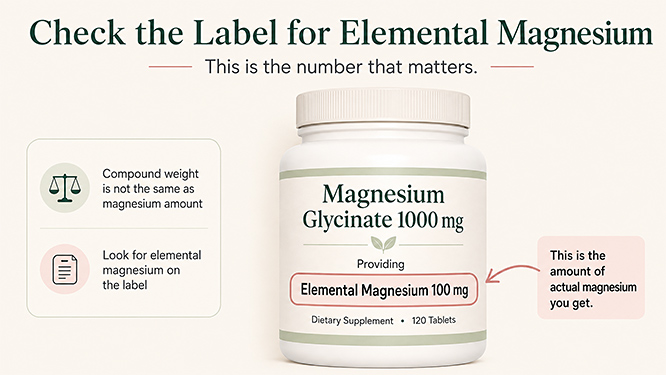
The most important thing is to check the amount of elemental magnesium on the label. This is the actual amount of magnesium you are getting, not just the total weight of the compound.
Start low and check the “elemental magnesium”
A sensible starting point for many adults is around 100 mg of elemental magnesium a day. If you tolerate it well, you could increase to 200 mg a day.
The upper limit for magnesium from supplements is 350 mg a day for adults, unless a doctor advises otherwise. This limit only applies to magnesium from supplements or medicines, not magnesium from food. The NIH explains this in its magnesium fact sheet.
Taking too much magnesium can cause diarrhoea, nausea and stomach cramps. People with kidney problems need to be especially careful, because the kidneys help clear extra magnesium from the body.
Why taking more is not always better
With magnesium, more is not always better.
A 1991 study on magnesium absorption found that the percentage of magnesium absorbed dropped as the dose increased. So taking one large dose may not be the most efficient way to do it.
It may also be harder on your stomach. This is why some people do better by splitting the dose.
For example:
- 100 mg with dinner
- or 100 mg with dinner and another 100 mg later in the evening
This may be easier to tolerate than taking one larger dose all at once.
When to take magnesium for night leg cramps
If your leg cramps happen at night, taking magnesium in the evening makes sense.
You can take it with food if it bothers your stomach. For many people, taking it with dinner or later in the evening is the easiest routine.
The exact timing probably matters less than taking it consistently.
When leg cramps should be checked
Leg cramps are usually harmless, but they should not be ignored if they are happening often, getting worse, or affecting your sleep.
It’s worth speaking to a doctor or pharmacist if:
- your cramps are frequent or very painful
- one leg is swollen, red, warm or tender
- you also have numbness, tingling or weakness
- the cramps started after taking a new medication
- you have kidney problems
- you are pregnant
- you have tried magnesium for a while and the cramps keep coming back
This is not to make you worry, but leg cramps are not always about magnesium. Sometimes they can be linked to medication, circulation, nerves, pregnancy, dehydration or another mineral imbalance, so it’s worth getting them checked if something feels off.
So, is magnesium worth trying for muscle cramps?
Magnesium is worth trying if your diet is low in magnesium, you have other signs you may not be getting enough, or you simply want to see whether it helps.
But it is not a guaranteed fix. The research is mixed, and leg cramps can have many causes, so it’s best to keep expectations realistic.
If you do try it, magnesium glycinate or bisglycinate is a sensible place to start. Magnesium citrate is another good option if constipation is also an issue. Start low, check the elemental magnesium on the label, and give it a few weeks while also paying attention to other possible causes of cramps.
FAQs
Can you get enough magnesium from food?
Yes, it is possible to get enough magnesium from food, especially if you regularly eat things like pumpkin seeds, chia seeds, almonds, cashews, spinach, black beans, oats and whole grains. Food sources are also less likely to cause problems than high-dose supplements, because the upper limit only applies to magnesium from supplements and medicines, not magnesium naturally found in food.
How long should you give magnesium before deciding it doesn’t work?
I would not judge it after just a few days. If you tolerate it well, give it around 4 to 8 weeks while also looking at other possible causes of cramps. But don’t keep increasing the dose endlessly if nothing changes.
Do magnesium sprays and lotions work for leg cramps?
Magnesium sprays, lotions and bath flakes may feel soothing, and some people like using them. But the evidence that magnesium is well absorbed through the skin is still limited, so I wouldn’t rely on topical magnesium as the main way to correct low magnesium intake.
What if magnesium does not help my leg cramps?
If magnesium does not help, the cramps may be caused by something else. Look at things like hydration, stretching, exercise, standing for long periods, medication, pregnancy, circulation, nerves, or other mineral imbalances. If cramps keep disturbing your sleep, come with numbness or swelling, or last longer than 10 minutes, it is worth speaking to a GP.
Is magnesium safe for leg cramps in pregnancy?
Magnesium is an important mineral in pregnancy, but it is best not to add extra supplements without checking first. Pregnancy cramps are common, and the research on magnesium is mixed, so speak to your midwife or doctor before taking extra magnesium, especially if you already take a prenatal supplement.
Can too much magnesium cause problems?
Yes. Too much magnesium from supplements can cause diarrhoea, nausea and stomach cramps. Very high intakes can be more serious, especially for people with kidney problems, because the kidneys help clear extra magnesium from the body. The adult upper limit for magnesium from supplements is 350 mg per day, unless advised otherwise by a healthcare professional.