Recently updated on January 27th, 2026 at 10:13 am
Doesn’t Krave sound a little bit healthier than it really is when you first look at the box? It’s got added vitamins and iron, and it proudly says it has no artificial colours or flavours.
But Krave isn’t a healthy everyday cereal. It’s high in sugar, the filling contains vegetable oils (including palm), and a bowl of it won’t keep you full for long because it’s only modest in protein and not particularly high in fibre.
So while it might give you a quick burst of energy, you’ll likely be hungry again soon after (and craving something sweet).
Stick with me and I’ll break it all down, including a few better alternatives.
Ingredients, made simple
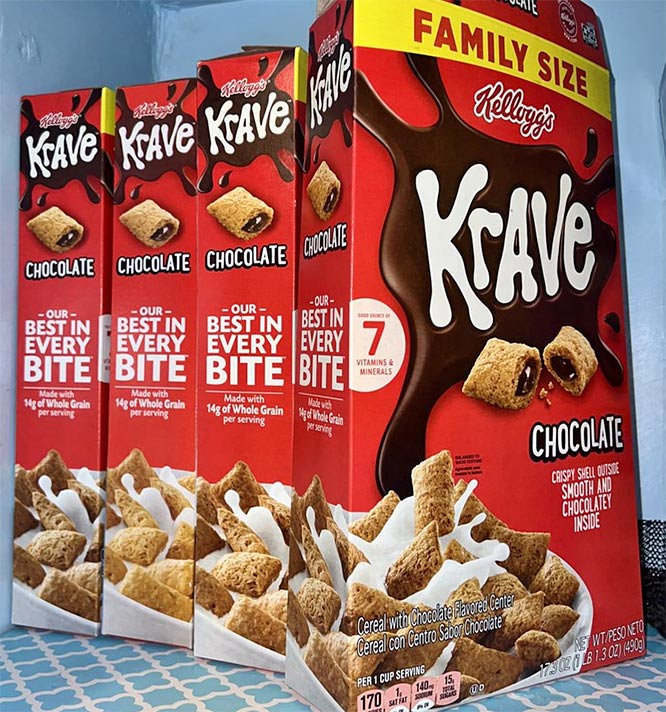
Krave is basically cereal flours on the outside with a sweet, chocolate-style filling inside. The label makes that pretty clear.
Note: this breakdown is for Kellogg’s Krave Milk Chocolate flavour. Other flavours can vary slightly.
The main ingredients (and why they matter)
- Cereal flours (55%): wheat, oat, rice
This is the crunchy shell. It’s mostly carbohydrate, and it’s quite refined, so it tends to digest quickly. That’s one reason Krave doesn’t keep you full for very long on its own. - Sugars (more than one type)
You’re not just dealing with “sugar” once. It includes added sugar, plus sugar coming from the milk chocolate, plus glucose syrup. When sugar shows up in a few different forms, it usually means the product is relying heavily on sweetness overall. - Vegetable oils (rapeseed and palm)
These are part of the filling and are mainly there for texture and stability in the product. Nutrition-wise, they add extra calories without adding much else, and palm oil also bumps up the saturated fat. - Milk chocolate and cocoa components
The filling includes milk chocolate and cocoa-related ingredients (like cocoa mass/cocoa powder). You’ll also see milk powders and whey powder listed because they’re part of that milk-chocolate style filling and help with the creamy taste and texture. They’re not there to make this a meaningful protein source. - Added vitamins and minerals
B vitamins and iron. Nice to have, but it doesn’t change what the cereal is mostly made of. - The “extras” (not the main issue)
Salt, natural colours (annatto norbixin, carotenes), soy lecithin (helps keep the filling mixed), and antioxidants (Ascorbyl Palmitate, Alpha Tocopherol) to help prevent oxidation.
What stands out most
- The filling is the biggest red flag: it’s built around sugars and oils, which is why Krave eats more like a sweet snack than a balanced breakfast.
- The base is mostly flour: so overall it’s easy to eat quickly and often not very satisfying, especially if you’re hungry and expecting it to keep you going.
Nutrition facts at a glance
Numbers matter, but so does portion size. The label is based on 30g, but that’s a small bowl. Most people pour more like 45–60g for breakfast.
These figures are for Kellogg’s Krave Milk Chocolate flavour (values can differ a bit between flavours).
| Nutrition | Per 100g | Per 30g serving |
| Calories | 454 kcal | 136 kcal |
| Sugar | 25 g | 7.5 g |
| Fibre | 3.7 g | 1.1 g |
| Protein | 7.0 g | 2.1 g |
| Fat | 15 g | 4.5 g |
| Saturates | 4.7 g | 1.4 g |
| Salt | 0.96 g | 0.29 g |
Key takeaways from the label:
- Sugar: Krave has 25g sugar per 100g, which puts it firmly in the high-sugar category.
- Protein: It’s modest, not high. Even a standard serving only gives you a couple of grams.
- Fibre: It’s on the lower side. You get a bit, but not enough to make this a filling breakfast on its own.
- Fat: Not huge per serving, but it creeps up fast with a bigger bowl, and saturates come along for the ride too.
What a more realistic bowl looks like
Here’s how quickly calories and sugar climb once you go beyond the “perfect” 30g serving.
| Bowl size (cereal only) | Calories | Sugar | Sugar in teaspoons |
| 30g (recommended serving) | 136 kcal | 7.5 g | almost 2 tsp |
| 45g | 204 kcal | 11.3 g | about 3 tsp |
| 60g | 272 kcal | 15 g | almost 4 tsp |
And if you add milk, the calories go up again. As a rough guide, 120ml semi-skimmed milk adds about 61 calories, so a 30g bowl comes to around 197 calories, a 45g bowl to around 265 calories, and a 60g bowl to around 333 calories.
This is why Krave often feels satisfying for a short time, then leaves you hungry again. You’re getting plenty of quick carbs and sugar, but not much fibre or protein to keep you full.
What about the added vitamins and iron?
Krave is fortified, so a 30g serving gives you a decent chunk of several B vitamins (25% of the recommended daily value), and iron is added too (Kellogg’s lists iron at about 17% per 30g for the Milk Chocolate flavour).
That said, added vitamins don’t turn a high-sugar cereal into a healthy breakfast. It’s still a high-sugar cereal with a sweet, oily filling.
If you still want Krave, here’s how to make it a bit better
I wouldn’t call Krave a good everyday breakfast, but if you genuinely love it, these small tweaks make a big difference.
- Keep the portion smaller. A 30g serving is small, but a huge bowl is where the sugar really climbs.
- Add protein, otherwise you’ll be hungry again fast. Try Greek yoghurt on the side, a couple of eggs, or use higher-protein milk instead of standard milk.
- Add fibre to slow things down. A handful of berries, a sliced banana, chia seeds, or a few nuts can help it feel more like breakfast and less like a snack.
- Think of it as “sometimes cereal.” More like a treat you have occasionally, not the thing you rely on every morning.
Better options instead (that actually keep you full)
If you’re choosing cereal because it’s quick, the goal is simple: less sugar, more fibre and protein. Here are a few easy options that are usually a better shout than Krave:
- Porridge oats (add Greek yoghurt, nuts, or berries for extra protein and fibre).
- Plain Weetabix or other wheat biscuits with milk or yoghurt plus fruit.
- Unsweetened muesli mixed with Greek yoghurt and a handful of berries.
A higher-fibre, lower-sugar cereal (then add your own sweetness with fruit instead of a chocolate filling).
My final take on Krave
Krave is best seen as a treat cereal, not a healthy everyday breakfast. It’s high in sugar, the filling contains oils (including palm), and it doesn’t offer enough fibre or protein to keep most people full for long, especially once you pour a normal-sized bowl.
If you love it, have it occasionally and make it more balanced by adding protein and fibre. But if you want a breakfast that genuinely keeps you going, you’re better off with one of the simpler options above (oats, wheat biscuits, unsweetened muesli, or a lower-sugar high-fibre cereal).
FAQs about Krave Cereal
Is Krave cereal good for weight loss?
It’s not ideal. It’s easy to eat a big portion, and it doesn’t keep you full for long, which can lead to snacking later. If weight loss is your goal, a lower-sugar, higher-fibre breakfast with more protein is usually a better choice.
Is Krave cereal fattening?
Any food can contribute to weight gain if you regularly eat more calories than you need. With Krave, the main issue is that portions creep up easily, and bigger bowls quickly push up calories and sugar.
Can kids eat Krave cereal every day?
I wouldn’t make it an everyday cereal. The sugar adds up quickly, and it’s not very filling. If your child loves it, keep it as an occasional option and pair it with something more filling (like yoghurt and fruit).
Can you eat Krave cereal when pregnant?
Yes, you can. It’s not unsafe in the way some foods are, but it’s still a high-sugar cereal, so it’s better as an occasional choice rather than a daily breakfast.
Is Krave cereal high in sugar?
Yes. It contains 25g of sugar per 100g, which is high. And most people eat more than the 30g “serving” so a typical 45–60g bowl often ends up closer to 11–15g of sugar, before you add milk.
Is Krave cereal ultra-processed?
Yes, it falls into the ultra-processed category because it’s a packaged cereal with a long ingredient list, added flavours/colours/emulsifier, and added vitamins and minerals.
Why does Krave give me diarrhoea (or stomach cramps)?
For some people, it can be too much sugar, the fats in the filling, or an ingredient you don’t tolerate well. It also contains wheat, and some people react to gluten or wheat in general. If it happens consistently, it’s a good idea to stop eating it and speak to a healthcare professional if symptoms persist.
Is Krave gluten-free?
No. It contains wheat, so it’s not suitable for a gluten-free diet.
More cereal label breakdowns
If you’re comparing cereals and want a few more quick, honest breakdowns, here are some I’ve looked at too:
- Are Rice Krispies Healthy?
- Is Alpen Muesli Good for You?
- Are Shreddies Healthy?
- Is Special K Cereal Healthy? What the Label Really Tells You
- Are Bran Flakes Good For You?
- Is Kellogg’s All-Bran Cereal Good for You?

Petra Nakashian (previously Kravos) has been writing about health and healthy living for over 10 years. She covers nutrition, natural health, and everyday wellness topics, with a focus on clear, practical advice you can actually use. Petra enjoys digging into health books, studies, and reputable research to check health claims, because there’s a lot of advice online that sounds convincing but isn’t accurate.