
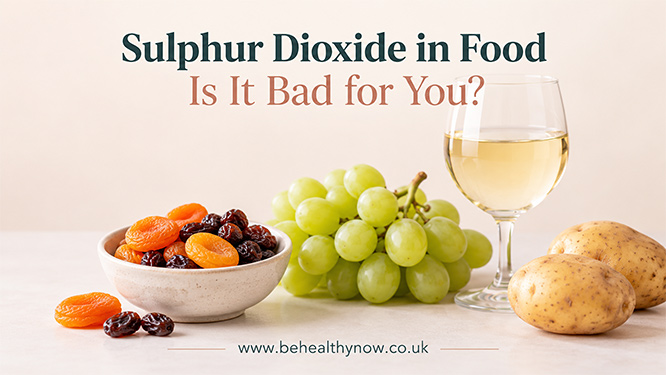
If you’ve noticed sulphur dioxide on a food label, you may have wondered whether it’s safe or something you should avoid.
For most people, the amounts found in food don’t seem to cause a problem. But some people are sensitive to it, and there are also questions around the possible effects of higher long-term intake.
So, is sulphur dioxide in food actually bad for you? Let’s look at what the research says.
What is sulphur dioxide in food, and why is it used?
Sulphur dioxide, or SO₂, is a food additive also known as E220. In the US, you’ll usually see it spelt sulfur dioxide, but it’s the same thing.
It is mainly used to help food last longer and stop it from changing colour. It can slow down the growth of bacteria and fungi and also works as an antioxidant, which means it helps protect food from changes caused by exposure to oxygen.
Sulphur dioxide is also widely used in winemaking, where it helps protect the wine from spoilage and unwanted changes during production and storage. EFSA lists it as both a preservative and antioxidant and notes that it can be used to stop ongoing fermentation in wine.
Is sulphur dioxide the same as sulphites?
Not exactly, although the two are very closely related.
Sulphur dioxide itself is not technically a sulphite, but once it is in food or liquid, it can change into different sulphite forms. This is why food safety authorities usually assess sulphur dioxide and sulphites together rather than treating them as completely separate additives.
You may see any of the following on food labels:
| E number | Name |
|---|---|
| E220 | Sulphur dioxide |
| E221 | Sodium sulphite |
| E222 | Sodium bisulphite |
| E223 | Sodium metabisulphite |
| E224 | Potassium metabisulphite |
| E226 | Calcium sulphite |
| E227 | Calcium bisulphite |
| E228 | Potassium bisulphite |
Together, these are often referred to as sulphur dioxide and sulphites (E220–E228).
What foods contain sulphur dioxide?
Sulphur dioxide and other sulphites can turn up in quite a wide range of foods, but not every food in the categories below will contain them. It depends on the product, how it was made and the rules in the country where it is sold.
Some of the more common sources include:
| Food group | Examples |
|---|---|
| Dried fruit | Dried apricots, peaches, apples, pears, raisins, sultanas, figs, prunes, bananas and some dried mango, pineapple and coconut |
| Alcoholic drinks | Wine, cider, some beers and fruit wines |
| Fruit juices and drinks | Certain fruit juices and juice concentrates |
| Potato products | Some peeled, frozen and dehydrated potato products |
| Processed vegetables | Some pickled vegetables, dried vegetables, mushrooms and vegetable preparations |
| Seafood | Prawns/shrimp and some other crustaceans and seafood |
| Meat products | Some breakfast sausages and certain prepared burger meats |
| Other foods | Vinegar, some jams and marmalades and certain other processed foods |
The Food Standards Agency’s information on sulphur dioxide in food also lists foods such as wine, dried fruit, pickled vegetables, sausages, fruit and vegetable juices, cider and vinegar.
Sulphur dioxide is used for different reasons depending on the food. In wine it helps prevent oxidation and spoilage, while in potatoes it helps prevent browning. In prawns and other crustaceans, it can be used to stop dark spots developing during storage.
How much sulphur dioxide is in dried fruit?
Dried fruit can be one of the more concentrated sources of sulphur dioxide. It is mainly used to slow down browning and help the fruit keep its colour, which is why sulphited dried apricots can stay bright orange while unsulphured ones are usually much darker.
The amount varies depending on the fruit and how it has been processed.
UK rules give maximum amounts in milligrams per kilogram, but it is more useful to look at what that could mean in a normal portion. The NHS considers around 30 g of dried fruit to be one adult portion.
| Type of dried fruit | Maximum permitted level | What that could mean in a 30 g portion |
|---|---|---|
| Dried coconut | 50 mg/kg | Up to 1.5 mg |
| Some other dried fruits | 500 mg/kg | Up to 15 mg |
| Dried apples and pears | 600 mg/kg | Up to 18 mg |
| Dried bananas | 1,000 mg/kg | Up to 30 mg |
| Dried apricots, peaches, raisins/sultanas, prunes and figs | 2,000 mg/kg | Up to 60 mg |
These figures are based on the maximum permitted levels for sulphur dioxide and sulphites in UK food regulations.
These are maximum permitted amounts, not typical amounts in every packet. A product may contain much less.
Is sulphur dioxide in dried fruit bad for you?
For most people, eating a small portion of sulphited dried fruit now and then is unlikely to be a problem.
It matters more if you are sensitive to sulphites or eat sulphited dried fruit regularly, as it can make a bigger contribution to your overall intake.
If you want to reduce your intake, look for dried fruit labelled unsulphured or no added sulphites. It may look darker, especially dried apricots, but that is simply because it has not been treated to prevent browning.
Why is sulphur dioxide used on grapes?
Fresh grapes are a slightly different case because sulphur dioxide may be used after harvesting rather than being added as an ingredient.
It helps control mould while grapes are being stored and transported. In some cases, special pads inside the packaging slowly release sulphur dioxide around the fruit.
UK rules allow up to 10 mg/kg on fresh table grapes. To put that into perspective, 100 g of grapes at the maximum permitted level would contain up to about 1 mg of sulphur dioxide, compared with up to 60 mg in a 30 g portion of some dried fruits.
These are maximum limits, but the comparison shows how much sulphite levels can vary between foods.
How can you tell if food contains sulphur dioxide?
The easiest way is to check the ingredients list.
You might see sulphur dioxide, sulfur dioxide, sulphites, E220, another sulphite E number from E221 to E228, or names such as sodium metabisulphite and potassium metabisulphite.
In the UK, sulphur dioxide and sulphites must be declared as an allergen when they are present at more than 10 mg/kg or 10 mg/litre, calculated as sulphur dioxide.
It is worth knowing that 10 mg/kg is a labelling threshold, not a recommended daily limit. It doesn’t mean that 9 mg/kg has been proven completely safe while 11 mg/kg is dangerous. We need to look at overall intake and the health evidence separately.
Is sulphur dioxide in food bad for you?
For most people, small amounts of sulphur dioxide in food are unlikely to cause harm. But people who are sensitive to sulphites can react to it, and we still don’t know enough about the effects of higher long-term intake.
The best-established problem is sulphite sensitivity, so let’s look at that first.
Sulphite sensitivity is the best-established problem
Some people are sensitive to sulphur dioxide and other sulphites and may develop symptoms after consuming them.
This is often described as a sulphite sensitivity or intolerance, rather than a straightforward food allergy. The exact reason these reactions happen is still not completely understood, and they do not always involve the same type of immune response that we see with a typical food allergy.
In people who are sensitive, symptoms can include:
- wheezing, coughing or difficulty breathing
- hives, itching or flushing
- stomach pain or diarrhoea
More serious reactions, including severe asthma attacks and anaphylaxis, have also been reported, although these are much less common.
A review of adverse reactions to sulphite additives found that respiratory symptoms are the most common type of reaction, particularly in people who already have asthma.
People with asthma are more likely to react
Sulphite sensitivity appears to be much more common in people with asthma than in people without it.
Studies have estimated that around 3–10% of people with asthma may react to sulphites, although the exact number is difficult to pin down. The risk also does not seem to be the same for everyone with asthma.
People with more severe asthma, particularly those with very sensitive airways or asthma that requires steroid treatment, appear to be more likely to react.
The most common reaction is bronchoconstriction, which simply means that the muscles around the airways tighten, making it harder to breathe. This can cause wheezing, coughing, chest tightness or shortness of breath.
You can read more about this in this research review on sulphite sensitivity in people with asthma.
This does not mean that everyone with asthma needs to avoid sulphites. Most people with asthma do not appear to be sulphite-sensitive. But if certain foods or drinks repeatedly seem to trigger breathing problems, sulphites are one possible cause worth considering.
What about other possible side effects of sulphur dioxide?
Research looking at sulphur dioxide on its own is limited, so some of the evidence comes from studies of sulphites more generally.
- Headaches and migraines: A small study on sulphur dioxide in wine and headaches found that people already prone to wine-related headaches were more likely to develop one after drinking wine with higher sulphur dioxide levels. However, wine contains other possible headache triggers too, so the evidence is still limited.
- Digestive problems: Stomach pain, nausea and diarrhoea can occur as part of a sulphite reaction, especially in people who are sensitive.
- Gas and bloating: There is currently no good evidence that sulphur dioxide commonly causes gas or bloating. Some laboratory research has looked at effects on gut bacteria, but we do not yet know whether this has any real effect in people.
Why has EFSA raised concerns about higher sulphite intake?
EFSA, the European Food Safety Authority, is the organisation that assesses food safety risks in the EU.
It has looked closely at sulphur dioxide and other sulphites because there are still some gaps in the research, especially when it comes to higher long-term intake.
There is no longer an EFSA acceptable daily intake
EFSA used to have a temporary acceptable daily intake of 0.7 mg of sulphur dioxide equivalents per kilogram of body weight per day.
But in 2022, it removed this limit.
This does not mean that 0.7 mg/kg was suddenly found to be harmful. It means EFSA did not have enough good-quality evidence to set a daily amount it could confidently say was safe over a lifetime.
You can read more in EFSA’s 2022 reassessment of sulphur dioxide and sulphites.
Why is EFSA concerned about higher intake?
The main concern comes from animal studies.
Some found changes in nerve signalling, learning and memory after higher sulphite exposure. EFSA then compared these amounts with how much people may get from food.
For some high consumers, the gap was smaller than EFSA would like to see. This does not mean that these people are developing brain or nerve damage. It simply means there is less of a safety margin.
A newer EFSA dietary exposure assessment from 2025 also found that exposure could still be relatively high in some groups, particularly toddlers and other high consumers.
Researchers have also looked at the fact that sulphites can break down vitamin B1, but there is no good evidence that normal dietary intake causes vitamin B1 deficiency in people.
Can sulphur dioxide in food cause cancer?
There is currently no proof that sulphur dioxide in food causes cancer, but some newer research has raised questions about sulphites more generally.
A large 2026 study followed more than 100,000 people and looked at their intake of food preservatives, including sulphites.
People with a higher intake of added sulphites as a group had a slightly higher overall cancer risk. Potassium metabisulphite, or E224, also showed an individual link.
However, sulphur dioxide itself, E220, was not one of the individual additives linked with a significant increase in cancer risk.
This was an observational study, so it cannot prove that sulphites caused the cancers. Other differences in diet and lifestyle may still have played a part.
EFSA has also looked at whether sulphur dioxide and other sulphites can damage DNA and found no current concern when E220–E228 are used as food additives.
You can read more in EFSA’s assessment of sulphur dioxide and sulphites.
Older animal studies have also not clearly shown that sulphites in food cause cancer.
For now, sulphur dioxide has not been proven to cause cancer, and the newer findings on sulphites still need to be confirmed by further research.
What other long-term effects are researchers studying?
Research is also looking at a few other possible long-term effects, although the evidence is still early:
- Blood pressure: A 2026 study on sulphite intake and high blood pressure found a small association between higher sulphite intake and hypertension. However, it was an observational study, so it cannot prove that sulphites caused it.
- Gut health: Laboratory and animal studies suggest sulphites may affect gut bacteria and processes linked with inflammation. For example, research on sulphites and the gut found changes in intestinal cells and mice, but we do not yet know whether the same thing happens in people.
- Fertility: Some animal studies have found effects on sperm, the testes and the ovaries. A 2025 study on sulphites and ovarian health found changes in mice, but there is no good evidence that normal dietary sulphite intake affects fertility in humans.
Should you avoid sulphur dioxide in food?
Most people probably do not need to avoid sulphur dioxide completely, but it makes sense not to have a high intake regularly.
If you are sensitive to sulphites, avoid foods that trigger symptoms and check labels for E220–E228.
If you have asthma, you do not automatically need to avoid sulphites. But if sulphite-containing foods repeatedly cause wheezing, coughing or breathing problems, speak to a healthcare professional.
For everyone else, occasional exposure is unlikely to be a problem. But because there are still some unanswered questions about higher long-term intake, choosing unsulphured alternatives sometimes is a simple way to reduce your overall exposure.
Frequently asked questions
Can babies have sulphur dioxide in food?
Yes. Babies can have small amounts of sulphur dioxide from ordinary foods, although added sulphites are generally not permitted in foods made specifically for babies and young children. Because babies have a much lower body weight, it makes sense not to give large amounts of high-sulphite foods such as sulphited dried fruit regularly.
Can you have sulphur dioxide when pregnant?
Yes. There is no general recommendation to avoid sulphur dioxide or sulphites during pregnancy.
The NHS guidance on foods to avoid during pregnancy does not list sulphites as something pregnant women need to avoid.
If you are sensitive to sulphites, you should still avoid foods that trigger symptoms. Wine should of course be avoided during pregnancy because of the alcohol, not because of the sulphur dioxide.
Does all beer contain sulphur dioxide?
No. Not all beer contains added sulphur dioxide.
However, yeast can naturally produce small amounts during fermentation, so beer may contain some sulphur dioxide even when none has been added.
Some beers may also have sulphites added during production. If you are sulphite-sensitive, check the label. In the UK, sulphites must be declared when present above 10 mg/litre.
Does cooking remove sulphur dioxide?
Cooking can reduce sulphur dioxide, but it does not reliably remove all of it.
How much is lost depends on the food and the cooking method. Research looking at sulphite levels after cooking found that cooking reduced the amount in some foods, but the results varied.
Can you wash sulphur dioxide off grapes or dried fruit?
Washing or soaking may remove some sulphur dioxide, but it is unlikely to remove all of it.
With dried fruit, soaking can reduce the amount present, especially in warm water, but some sulphites can remain in the fruit.
For fresh grapes, there is not enough good research to say exactly how much an ordinary rinse removes. If you are sensitive to sulphites, washing should not be relied on to remove them completely.
Are sulphites naturally present in food?
Yes. Sulphites can form naturally during processes such as fermentation.
This is why fermented foods and drinks such as wine and beer may contain some sulphites even when none have been deliberately added. Sulphur dioxide and other sulphites can also be added separately to foods as preservatives.