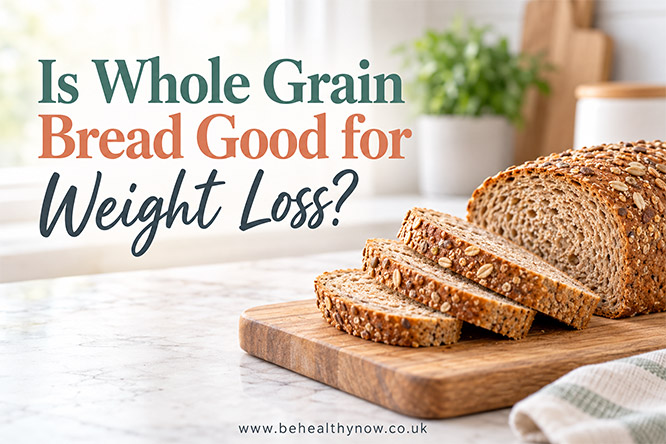
If you’re trying to lose weight, you don’t need to stop eating bread. Whole grain bread can actually be a good choice because it is usually higher in fibre and often higher in protein than white bread. Both can help make it more filling and keep you satisfied for longer.
Whole grain bread includes whole wheat bread, which is a term you’ll see more often in the US, wholemeal bread in the UK, and breads made with other whole grains such as rye.
Research suggests whole grains can help with fullness, but simply switching your bread isn’t likely to make you lose weight on its own. Think of it as one useful change that can make a healthier diet easier to stick to.
What does the research say about whole grain bread and weight loss?
Research is quite consistent that whole grains can help with fullness, but the effect on actual weight loss is much less clear. Some studies have found a small benefit, while others show little or no difference compared with refined grains.
| What researchers looked at | What they found |
|---|---|
| Hunger and fullness | Whole grains generally reduced hunger and increased fullness and satiety compared with refined grains. |
| How much people ate | People tended to eat slightly less after whole grains, but overall the reduction in calorie intake was not statistically significant. |
| Body weight | Earlier reviews found little or no meaningful difference in weight loss between whole-grain and refined-grain diets. |
| Newest evidence | A large 2026 analysis found a small reduction in body weight and waist size with higher whole-grain intake, but the average effect was modest. |
Whole grains may help you feel fuller
One of the main reasons whole grain bread may be useful for weight loss is that it can be more filling.
A 2021 systematic review and meta-analysis of 32 trials found that whole-grain foods reduced hunger and the desire to eat, while increasing fullness and satiety compared with refined grains. Interestingly, though, this didn’t lead to a significant reduction in how many calories people ate overall.
There is some bread-specific research too. In one small study, people who ate whole grain bread felt more satisfied and ate less later in the day than when they ate conventional bread. It was only a small study of 11 people, so I wouldn’t read too much into it, but it supports the idea that the type of bread you choose can affect how full you feel.
But does it actually lead to weight loss?
This is where the evidence becomes less clear.
A meta-analysis of 21 clinical trials involving almost 1,800 adults found no significant difference in body weight, BMI or waist circumference when people ate more whole grains rather than refined grains.
Another review found a similar pattern. People who regularly ate more whole grains tended to have a lower BMI and gain less weight over time, but this wasn’t confirmed in the randomised trials included in the review. The researchers pointed out that longer trials are needed.
Newer research suggests there may be a small effect
More recent research is a little more encouraging. A 2026 meta-analysis of 87 randomised trials found that every additional 48g of whole grains per day was linked with an average reduction of around 0.2kg in body weight and 0.22cm around the waist.
That’s a very small difference, but it does suggest that whole grains may have a modest effect when eaten regularly.
What about rye?
Rye is another whole grain worth mentioning, especially as rye bread can be a good source of fibre.
In a 2021 trial of 242 adults with overweight or obesity, participants followed a lower-calorie diet containing either high-fibre rye foods or refined wheat foods. After 12 weeks, the rye group had lost around 1kg more weight and slightly more body fat.
However, a newer 2026 trial didn’t find the same benefit. Both groups lost weight while following a lower-calorie diet, but there was no significant difference between those eating wholegrain rye foods and those eating refined wheat foods.
So rye can certainly be a good high-fibre choice, but the evidence doesn’t show consistently that choosing rye will lead to greater weight loss.
So what does this mean for you?
Whole grain bread isn’t a weight-loss food in the sense that eating it will automatically make the weight come off.
Its main advantage is more practical: if the bread you choose is higher in fibre and protein and keeps you full for longer, you may find it easier to manage hunger and make better food choices during the day.
This is also why the NHS recommends choosing wholegrain starchy foods when you’re trying to lose weight. Their higher fibre content can help you feel full, making you less likely to eat too much.
Whole grain vs white bread for weight loss: which is better?
Whole grain bread is usually the better everyday choice if you’re trying to lose weight, but not because it is much lower in calories.
In fact, the calorie difference between whole grain and white bread is often quite small. Sometimes white bread can even look lower in calories per slice, simply because the slices are smaller.
| Whole grain bread | White bread | |
|---|---|---|
| Calories | Usually similar | Usually similar |
| Fibre | Higher | Lower |
| Protein | Often higher | Often lower |
| Fullness | Usually more filling | Often less filling |
| If you are trying to lose weight | Usually the more nutritious, higher-fibre choice | Can still fit into a weight-loss diet |
Don’t judge bread by calories per slice alone
Calories per slice can be misleading because bread slices vary so much in size.
A small white slice may contain fewer calories than a thick slice of whole grain bread, but that doesn’t necessarily make it the better choice.
If you want to compare breads properly, look at the nutrition per 100g as well as per slice.
The biggest difference is usually fibre
This is where whole grain bread tends to have a clear advantage.
As a rough guide, many wholemeal breads provide around 6g or more of fibre per 100g, while standard white breads are often closer to 2–3g.
Whole grain breads are often higher in protein too, although this varies between brands.
So rather than looking for the bread with the fewest calories, it makes more sense to look at the whole nutritional picture.
White bread can still fit into a weight-loss diet
You don’t have to completely avoid white bread if you enjoy it.
But if bread is something you eat regularly, choosing a higher-fibre whole grain loaf most of the time is an easy way to improve the quality of your diet without making a big change to what you eat.
I’ve compared the differences in more detail in my guide to whole grain bread vs white bread.
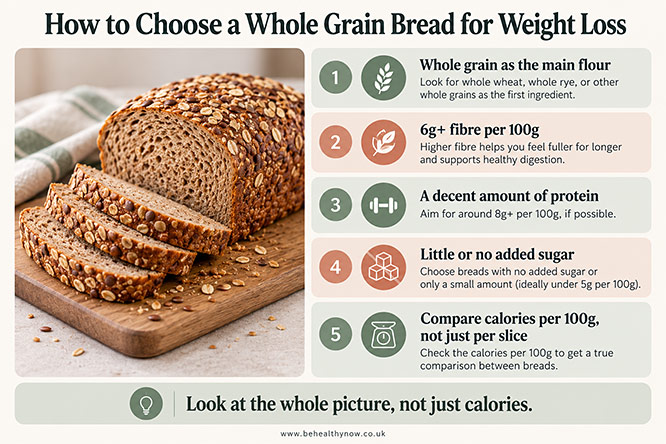
How to choose the best whole grain bread for weight loss
Not all whole grain breads are equally good choices, so it’s worth checking the label rather than relying on the front of the packet.
Here’s what I would look for.
Make sure it really is whole grain
A bread can look healthy without being made mainly from whole grains. Words such as multigrain, seeded or even brown bread don’t necessarily mean the loaf is 100% whole grain.
In the UK, look for wholemeal flour as the main flour. In the US, look for whole wheat flour or another whole grain as the main flour. If you specifically want 100% whole grain bread, check that refined flour hasn’t also been added.
A bread that contains a mixture of whole grain and refined flour isn’t necessarily a bad choice, but it may contain less fibre than one made entirely from whole grains.
Aim for plenty of fibre
For weight loss, fibre is one of the first things I would check.
As a simple guide, I like to look for around 6g of fibre per 100g or more. This is also the level at which a food can be described as high in fibre in the UK.
Some breads contain considerably more than this, especially rye, seeded and denser whole grain loaves.
Compare the protein
Protein varies quite a lot between breads, so it’s worth comparing a few similar options.
If one whole grain bread gives you noticeably more protein without a big jump in calories, that can be a good choice, especially if you want your meal to keep you going for longer.
Check for added sugar
Bread doesn’t need to taste sweet to contain added sugar.
Check the ingredients for things such as sugar, glucose syrup, honey or molasses. A small amount isn’t going to ruin your diet, but if you have a choice, I would usually go for a whole grain bread with little or no added sugar.
Compare calories fairly
If you’re comparing two breads, check the calories per 100g as well as per slice. Slice sizes vary, so the per-slice number doesn’t always give you a fair comparison.
Then look at the fibre and protein too, rather than automatically choosing the bread with the fewest calories.
The best whole grain bread for weight loss isn’t necessarily the one with the fewest calories. I’d look for a loaf that is genuinely whole grain, high in fibre, has a decent amount of protein and isn’t loaded with added sugar.
A few good whole grain breads to look for
There isn’t one perfect bread for weight loss, but these are some good examples that tick many of the boxes above.
UK options
- Jason’s Wholemeal Ciabattin – made with 100% wholemeal wheat flour and no added sugar. It provides 6.5g of fibre and 11.7g of protein per 100g, which is a good combination if you’re looking for something filling.
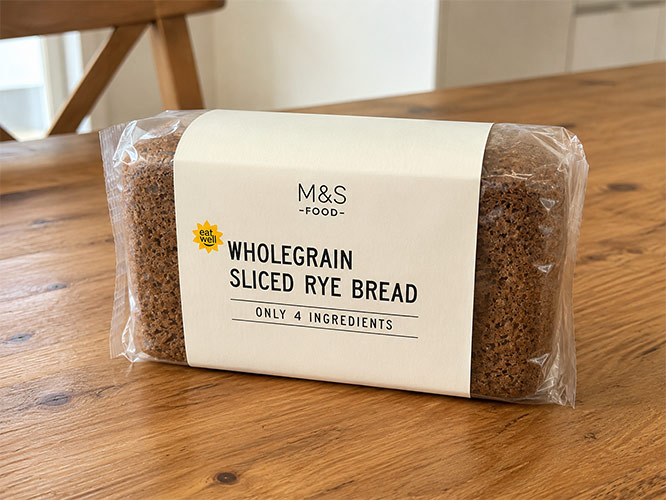
- M&S Only 4 Ingredients Wholegrain Sliced Rye Bread – made from wholegrain rye, water, salt and yeast. It contains an impressive 10.2g of fibre per 100g and no added sugar, although the protein is lower at 5g.
- Biona Organic Rye Bread with Chia & Flax – another very high-fibre option, with 11g of fibre and 6g of protein per 100g. It’s made mainly from wholegrain rye with flax and chia seeds and has no added sugar.
You can find more options in my guide to the healthiest bread in the UK.
US options
- Food for Life Ezekiel 4:9 Original Sprouted Whole Grain Bread – made with sprouted whole grains and legumes, with no added sugar. One 34g slice has 80 calories, 3g of fibre and 4g of protein.
- Dave’s Killer Bread Powerseed – made with whole wheat plus flax, oats, quinoa and other seeds. One slice provides 4g of fibre and 5g of protein for 90 calories, with 19g of whole grains. It does contain fruit juice for sweetness, but only 1g of total sugar per slice.
- Alvarado Street Bakery Whole Wheat Thin Sliced Bread – made with sprouted whole wheat and has no added sugar. One slice contains 3g of fibre and 4g of protein.
Recipes can change, so it’s always worth checking the ingredients and nutrition label when you buy.
FAQs
Is whole wheat bread good for weight loss?
Yes, it can be. Whole wheat bread is a type of whole grain bread made from the whole wheat kernel, so it usually contains more fibre than white bread and is often higher in protein too.
The main thing is to check the label. In the US, look for 100% whole wheat if you want a loaf made entirely from whole wheat flour.
Is multigrain bread good for weight loss?
It can be, but multigrain doesn’t automatically mean whole grain.
A multigrain bread simply contains more than one type of grain. Some of those grains may be refined, so the bread can still be relatively low in fibre.
Check the ingredients and nutrition label rather than relying on the word multigrain on the front of the pack. Ideally, whole grains should make up most of the flour, and the bread should provide a good amount of fibre.
How many slices of whole grain bread should I eat to lose weight?
There isn’t one number that works for everyone.
One or two slices can easily fit into many weight-loss diets, but what matters more is your overall calorie intake, what you eat with the bread and how the rest of your diet looks.
For example, two slices topped with eggs, cottage cheese or another protein source may make a much more filling meal than several slices eaten with a high-calorie spread.
Is whole grain bread fattening?
Whole grain bread isn’t inherently fattening.
Weight gain happens when you regularly eat more energy than your body uses. Whole grain bread still contains calories, so portion size matters, but it can be part of a healthy weight-loss diet.
In fact, because it tends to be higher in fibre and often protein, it may be more filling than white bread.
Can I eat whole grain bread every day and still lose weight?
Yes. You don’t need to avoid bread completely to lose weight.
Whole grain bread can fit into your diet every day as long as your overall diet supports your weight-loss goals. What you put on the bread matters too, so try to build meals around protein, vegetables and other filling foods rather than relying on bread alone.
The bottom line
Whole grain bread can be a good choice when you’re trying to lose weight, especially if you choose one that’s genuinely whole grain, high in fibre and has a decent amount of protein.
But don’t get too caught up in finding the “perfect” bread. Your overall diet and lifestyle matter much more. Choosing a better bread is simply one small, positive change that can help.