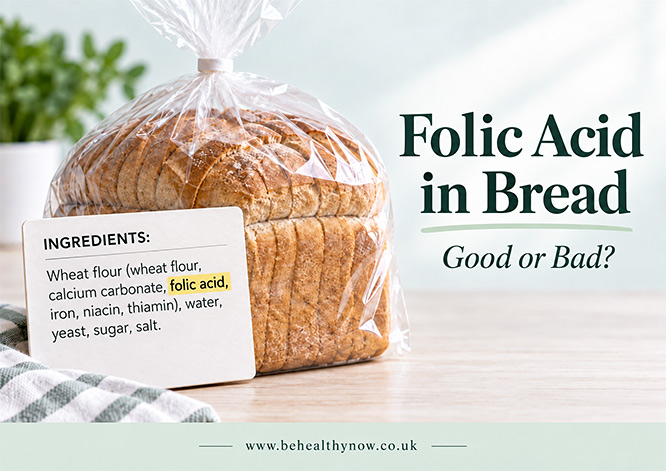
Folic acid has been added to bread and other grain products in the US for decades, and from December 2026 it will also be added to most non-wholemeal wheat flour in the UK. Canada and Australia already have similar fortification programmes.
It is added for a good reason. Folic acid can help prevent serious birth defects affecting the brain and spine. But folic acid is not the same form of folate naturally found in food, and questions remain about how the body processes it, how much we may consume from different foods, and whether long-term exposure could have unwanted effects.
So, is folic acid in bread actually good or bad for you?
The Short Answer
Folic acid in bread has a clear benefit because it helps prevent neural tube defects. There is no strong evidence that normal amounts in fortified bread cause disease, but some research has raised questions about long-term exposure and whether folic acid may affect certain people differently.
What Is Folic Acid and How Is It Different From Folate?
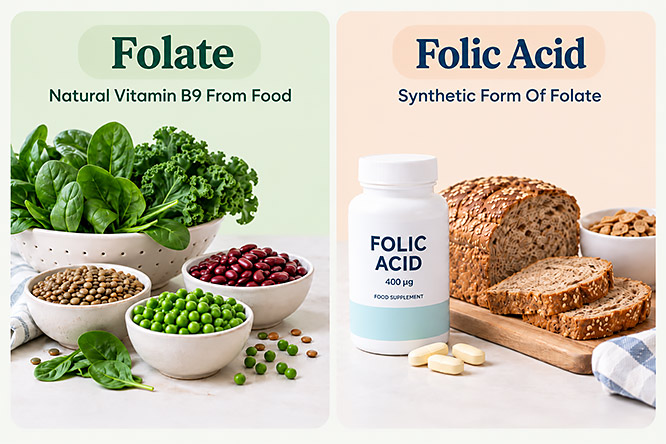
Folate is the name for a family of vitamin B9 compounds. It is naturally found in foods such as leafy greens, beans, peas and lentils.
Folic acid is a synthetic form of folate. It is commonly added to fortified foods and used in many supplements. So while folic acid belongs to the folate family, it is not the same form naturally found in food.
This difference matters because the body has to change folic acid into other forms before it can use it. We will come back to this later.
Does Folic Acid Really Prevent Neural Tube Defects?
Yes. This is where the evidence is quite strong.
Neural tube defects are serious birth defects affecting the baby’s brain and spine. They include conditions such as spina bifida and anencephaly.
A landmark randomised trial found that folic acid reduced the risk of another neural tube defect by 72% in women who had previously had an affected pregnancy.
A much larger study in China also found that taking 400 µg of folic acid a day around conception reduced the risk.
Why Does the Timing Matter?
The neural tube develops very early in pregnancy, often before a woman even knows she is pregnant.
Not every pregnancy is planned either, and some women only start taking folic acid once they find out.
This is one of the main reasons governments use fortification. Adding folic acid to everyday foods means more women are likely to be getting some before pregnancy begins.
Where Is Folic Acid Added to Bread? The US, UK and Beyond
Folic acid fortification is not new. The US and Canada have been doing it since 1998, while Australia introduced mandatory fortification in 2009. In the UK, the new rules become compulsory in December 2026, although some breads already contain added folic acid.
The rules are slightly different depending on where you live.
| Country | Main mandatory fortification | What about whole wheat/wholemeal? | Since |
|---|---|---|---|
| US | Enriched cereal grain products | 100% whole wheat is not automatically included | 1998 |
| UK | Non-wholemeal common wheat flour | The new rule does not apply to wholemeal wheat flour. | Compulsory from 13 Dec 2026 |
| Canada | Enriched white wheat flour | Whole wheat flour is not included in the mandatory rule | 1998 |
| Australia | Wheat flour used for bread-making | Wholemeal is included, but organic bread is exempt | 2009 |
Folic Acid in Bread in the US
If you live in the US, you have probably been eating added folic acid for years without really thinking about it.
The FDA lists enriched breads, flours, pastas, rice and cornmeal as foods fortified with folic acid. Certain breakfast cereals can contain it too.
The important word here is “enriched.” This does not mean every bowl of rice or every packet of pasta contains folic acid. It is the enriched versions that do.
Corn masa flour, used for foods such as tortillas and tamales, can also have folic acid added, although this is voluntary rather than mandatory.
What Is Changing in the UK?
From 13 December 2026, non-wholemeal common wheat flour must contain 250 µg of folic acid per 100 g of flour. Wholemeal common wheat flour is exempt.
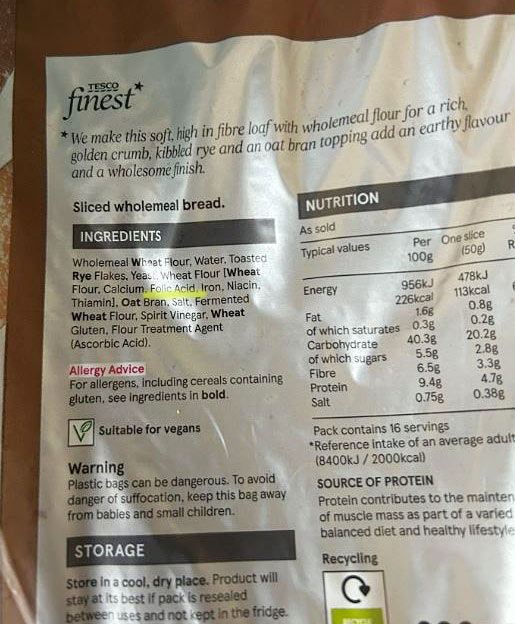
But you do not have to wait until December to find it. Some manufacturers have already made the change. For example, current ingredient lists for Tesco Medium Sliced White Bread, Hovis Signature White and Warburtons Farmhouse already show folic acid added to the wheat flour.
And it will not only be sliced bread. Once flour is fortified, it can also be used in rolls, sandwiches, pastries, cakes, biscuits and other foods made with that flour.
Canada
In Canada, the mandatory rule applies to white flour, which must contain 150 µg of folic acid per 100 g. Foods made with white flour, including bread, cookies and pastries, must use enriched flour. Whole wheat flour has its own separate standard and is not covered by this mandatory folic acid requirement.
Australia
Australia takes a slightly different approach. Wheat flour used for bread-making must contain folic acid, and this includes wholemeal bread. Organic bread is exempt. Foods such as cakes, pastries and biscuits are not automatically included in the bread fortification rule.
What About the Rest of Europe?
Mandatory folic acid fortification has been much less common across Europe.
A European Commission EUROCAT resource reported that, as of July 2023, Moldova was the only European country with mandatory folic acid fortification. Voluntary fortification of some foods is available in many European countries instead.
Has Fortification Actually Worked?
When we look at the main goal, preventing neural tube defects, the results are quite convincing.
| Country | What happened after fortification? |
|---|---|
| US | CDC surveillance found about a 28% reduction in spina bifida and anencephaly. The CDC now estimates that around 1,300 babies each year are born without a neural tube defect that might otherwise have been affected. |
| Canada | A large study of around 1.9 million births found neural tube defects fell by about 46%. |
| Australia | Neural tube defects fell by about 14% overall, and by 74% among Indigenous women, who had higher rates before fortification. |
So there is good evidence that fortification has reduced neural tube defects. But how much folic acid are we actually getting from bread and other foods?
How Much Folic Acid Is Actually in Bread?
The amount depends on where you live, the type of bread and the size of the slice. But we can get a good idea from the fortification rules in the US and UK.
How Much Folic Acid Is in One Slice?
In the US, enriched bread has contained folic acid for years. Under the US federal standard for enriched bread, enriched bread contains around 95 µg of folic acid per 100 g. For a 35 to 40 g slice, that works out at roughly 33 to 38 µg per slice.
In the UK, the new rule requires 250 µg of folic acid per 100 g of non-wholemeal wheat flour.
One UK study of bread manufacturing estimated that a typical 800 g loaf uses around 536 g of flour. That works out at roughly 27 to 30 g of flour in a 40 to 45 g slice.
At the new fortification level, that would provide around 67 to 75 µg of folic acid before baking. Some folic acid is lost during bread making, with studies finding losses of around 20 to 30%.
This puts a typical slice at roughly 50 to 60 µg of folic acid. A Federation of Bakers factsheet, citing the Health Food Manufacturers’ Association, also estimates around 60 µg per slice, depending on slice size.
| Bread eaten | US enriched bread* | UK fortified bread* |
|---|---|---|
| 1 normal slice | ~33 to 38 µg | ~50 to 60 µg |
| 2 slices | ~66 to 76 µg | ~100 to 120 µg |
| 4 slices | ~130 to 150 µg | ~200 to 240 µg |
| 6 slices | ~200 to 230 µg | ~300 to 360 µg |
*These are estimates. Bread recipes and slice sizes vary, and not every US bread is enriched.
Four Slices Can Add Up Quickly
Four slices in a day is not unusual. You might have two slices of toast for breakfast and another two in a sandwich at lunch.
That could give you around 130 to 150 µg of folic acid from US enriched bread, or around 200 to 240 µg from UK bread made with the newly fortified flour.
That does not mean these amounts are harmful. It simply shows why looking at one slice on its own does not tell us your total intake.
It Is Not Just Bread
Bread may be only one source of folic acid in your day.
Depending on where you live, you may also get it from rolls, buns, bagels, sandwiches and other foods made with fortified or enriched flour.
In the US, enriched pasta, rice and cornmeal can contain added folic acid too.
In the UK, fortified wheat flour can also find its way into foods such as pastries, cakes and biscuits.
Some breakfast cereals and cereal bars are fortified too (some provide around 50–60 µg per small serving, while others contain more), and multivitamins can add more again.
So the main point is simple: your folic acid intake may come from several foods in the same day, not just bread.
Why Are Some People Concerned About Folic Acid in Bread?
Most concerns are not about one slice of bread being toxic. They are more about how the body handles synthetic folic acid, how much we may get from different foods, and what regular exposure over many years could mean.
The Body Has to Process Folic Acid First
As we mentioned earlier, folic acid is not the same form of folate naturally found in food. Before the body can fully use it, it first has to change it into other forms.
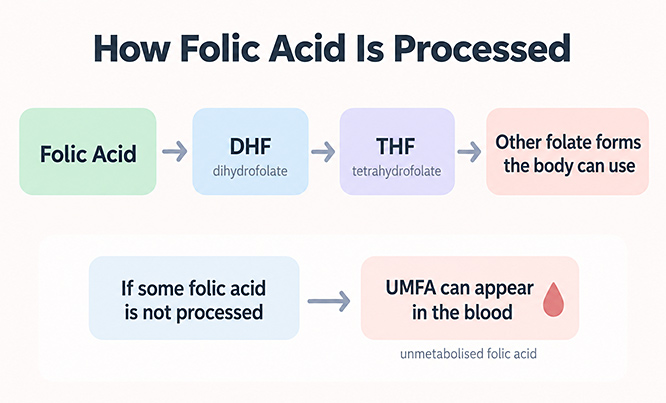
One of the enzymes that helps with this is called dihydrofolate reductase, or DHFR. Its job is to change folic acid step by step into a form the body can then use to make other folates it needs.
The process looks like this:
Folic acid → dihydrofolate (DHF) → tetrahydrofolate (THF) → other folate forms the body can use
THF is the important end point of these first steps. From there, the body can make other useful forms of folate.
Natural food folates do not need to go through these same first steps.
What makes this interesting is that DHFR seems to work quite slowly in humans. A human study looking at DHFR activity also found that it varied considerably from one person to another.
What About MTHFR?
You may have heard of MTHFR when people talk about folic acid.
MTHFR is an enzyme that helps the body turn folate into 5-MTHF, one of the main forms the body can use.
Some people have common MTHFR gene variants that make this step work less efficiently. These variants are actually very common. The CDC explains that more than half of people in the US have one or two copies of the common C677T variant.
Having an MTHFR variant does not mean that you cannot process folic acid. The CDC says people with these common variants can still process folic acid, although some may have slightly lower folate levels in their blood.
So MTHFR is worth knowing about, but having a common variant does not automatically mean folic acid is a problem.
What Happens if Some Folic Acid Is Left Unchanged?
Because the body may process folic acid quite slowly, some of it can reach the bloodstream before it has been changed into other forms. This is called unmetabolised folic acid, or UMFA.
We know UMFA can appear in the blood after people consume folic acid from fortified foods and supplements.
What we don’t yet know is whether regularly having UMFA in the blood over many years could have any effect on health.
A 2026 review of more than 60 studies on UMFA found that harmful effects have not been clearly proven. But the research is still limited and the findings are not always consistent.
So for now, this is an area of uncertainty, not proof that UMFA is harmful.
High Folic Acid Can Hide a Vitamin B12 Deficiency
Vitamin B12 and folate both help the body make healthy red blood cells.
How Can Folic Acid Hide the Problem?
If someone is low in B12, their red blood cells can become abnormal and anaemia may develop.
High amounts of folic acid can help the body make the red blood cells look more normal again. But it does not replace the missing B12.
This means the anaemia can improve even though the B12 deficiency is still there.
Why Does This Matter?
B12 deficiency can also affect the nerves. Folic acid does not fix that part of the problem, so nerve damage may continue even if the blood test looks better.
This is one reason high folic acid intake has been a concern in people with an undiagnosed B12 deficiency.
EFSA (the European Food Safety Authority) sets an adult upper level of 1,000 µg a day for supplemental folate, including folic acid, from fortified foods and supplements. Lower limits are set for children.
Bread alone is unlikely to provide anywhere near this amount. What matters more is the total amount coming from fortified foods and supplements combined.
Folic Acid May Affect the Immune System
There are also some questions about whether folic acid could affect the immune system.
In one human study, having detectable UMFA in the blood was linked with lower activity of natural killer (NK) cells. These are immune cells that help the body deal with infected or abnormal cells.
Another study found a drop in both the number and activity of NK cells after people took 5 mg (5,000 µg) of folic acid a day. This is a much higher amount than you would normally get from fortified food.
These findings raise some interesting questions, but they do not show that the amount of folic acid in ordinary fortified bread weakens the immune system.
Could Folic Acid Increase Cancer Risk?
This is a complicated area because folate is needed for making DNA and helping cells grow normally. But researchers have questioned whether high amounts of folic acid could also help cells that are already abnormal or precancerous to grow.
The research is mixed:
- One trial using 1 mg of folic acid a day: people taking folic acid were more likely to develop advanced bowel growths that can become cancerous. More prostate cancers were also seen in the folic acid group. See the study.
- Two Norwegian trials: more cancers and cancer deaths were seen in people taking folic acid together with vitamin B12. Because the two were taken together, we cannot blame folic acid alone. See the study.
- A much larger analysis of almost 50,000 people: found no clear increase in overall cancer or the main individual cancer types. See the analysis.
It is also important to put these findings into context. These studies used folic acid supplements, often at much higher amounts than you would get from bread.
So there are some findings worth paying attention to, but there is no good evidence that normal amounts of folic acid in fortified bread cause cancer.
We also have much less information about what regular exposure over several decades might mean.
High-Dose Folic Acid May Affect Folate Getting Into the Brain
The brain needs folate for normal function, including making and repairing cells and producing important brain chemicals.
One of the main forms it uses is called 5-MTHF. This form of folate has to move from the blood into the brain and into the cerebrospinal fluid (the clear fluid that surrounds the brain and spinal cord).
In a study of two people with cerebral folate deficiency (a rare condition where too little folate reaches the brain), high doses of folic acid appeared to interfere with this process.
This was a very small study in people with a specific medical condition who were taking much higher doses than you would get from bread. So it does not show that ordinary fortified bread has the same effect.
It does, however, raise another question that needs more research.
Not Everyone Wants Folic Acid Added to Their Food
There is also a much simpler concern: consumer choice.
Fortification is mainly intended to reduce neural tube defects by making sure more women get folic acid before they even know they are pregnant.
But fortified foods are eaten by everyone, including men, children, older adults and people who may already be taking folic acid in supplements.
Some people are happy with this because of the proven benefit in preventing birth defects. Others would prefer to decide for themselves whether they consume added synthetic folic acid.
Governments point out that alternatives are still available. In the UK, for example, wholemeal wheat flour does not have to contain added folic acid.
But avoiding it may still mean checking labels and being more selective about the bread and other flour-based foods you buy.
What About Folic Acid in Bread for Children?
Children can get folic acid from bread, breakfast cereals and other fortified foods, just like adults. But because they are smaller, the upper limits for children are much lower.
Children Have Lower Upper Limits
An upper level is a safety limit set for regular intake from fortified foods and supplements. It does not include the folate naturally found in foods such as vegetables, beans and lentils.
The limits are slightly different in Europe and the US, and the age groups are different too:
| Europe (EFSA) | Upper level | US | Upper level |
|---|---|---|---|
| 1 to 3 years | 200 µg/day | 1 to 3 years | 300 µg/day |
| 4 to 6 years | 300 µg/day | 4 to 8 years | 400 µg/day |
| 7 to 10 years | 400 µg/day | 9 to 13 years | 600 µg/day |
The European figures come from EFSA’s review of folate upper intake levels, while the US limits come from the NIH folate guidance.
It is important to remember that going above an upper level does not mean harm will happen. It is a safety limit for regular intake, not the point where folic acid suddenly becomes harmful.
What Did the UK Modelling Find?
UK modelling of folic acid fortification looked at how many children might go above their age-specific upper limit once the new fortification is included.
| Age | Estimated to go above the upper limit |
|---|---|
| 1½ to 3 years | 4.4% |
| 4 to 6 years | 1.4% |
| 7 to 10 years | 1.1% |
So the vast majority of children were still expected to stay below the upper limits. The youngest children were the group most likely to go over.
For parents, there is no reason to worry about one slice of bread. It is more useful to look at total intake, especially if a child also eats fortified cereals or takes a multivitamin containing folic acid.
What About Children With Autism?
There are some extra questions around folate in autistic children.
Some studies have found folate receptor antibodies in a proportion of autistic children. These antibodies can make it harder for folate to get into the brain.
There is also some evidence that folinic acid (a different form of folate) may help certain autistic children. Some research has found improvements in areas such as communication and autism-related symptoms, with some evidence of a better response in children with higher levels of folate receptor antibodies.
But this still leaves an important gap: we have very little research looking specifically at autistic children regularly eating synthetic folic acid from fortified foods.
So we cannot currently say that folic acid in bread is harmful for autistic children, but we also cannot say with certainty that it has no effect.
What Can Parents Do?
There is no evidence at the moment that all autistic children should avoid fortified bread.
But if a parent is concerned and their child gets folic acid from several fortified foods, they could look at where that added folic acid is coming from.
One option would be to choose similar foods without added folic acid for a period of time, while still making sure the child gets plenty of natural folate from foods such as vegetables, beans, peas and lentils.
This would be a personal dietary experiment rather than a proven autism treatment. We do not currently have good trials showing that removing folic acid from fortified foods improves autism symptoms.
And if a child’s diet is already quite limited, or supplements are involved, it is worth discussing any bigger changes with their doctor or dietitian first.
How to Avoid Folic Acid in Bread If You Want To
If you would rather avoid added folic acid, you do not necessarily need to stop eating bread. You just need to know what to look for.
How to Avoid Folic Acid in UK Bread
The easiest option is 100% wholemeal wheat bread. Wholemeal wheat flour is not included in the new mandatory folic acid rule.
Bread made entirely from other flours, such as rye, may also be an option because the UK rule applies specifically to non-wholemeal common wheat flour.
Just check the ingredients. Many breads that look dark, seeded or wholegrain still contain some non-wholemeal wheat flour.
How to Avoid Folic Acid in US Bread
In the US, the main word to watch for is “enriched”.
If the ingredients list says enriched wheat flour, it will normally contain added folic acid. The FDA lists enriched breads and flours among the foods fortified with folic acid.
A 100% whole-wheat bread is a better place to look if you want to avoid it, but still check the ingredients. Some breads contain a mixture of whole-wheat and enriched flour.
What About Organic or Rye Bread?
Organic bread is not automatically folic-acid-free. In the UK, there is no general organic exemption from the new flour fortification rule. In the US, organic foods can also contain added vitamins in certain circumstances, so the word “organic” alone is not enough to go by.
Rye bread can be a good option, but only if it is genuinely made without enriched or fortified wheat flour. Many supermarket rye breads are actually a mixture of rye and wheat flour.
So whatever bread you choose, the simplest thing is to check the ingredients rather than relying on the name on the front of the pack.
What Should You Look for on the Label?
The main name to look for is simply folic acid.
In UK legislation, you may also come across the technical name pteroylmonoglutamic acid. This is just the chemical name for folic acid.
You may also see vitamin B9 written alongside folic acid. But B9 is a general name for vitamin B9 compounds, including folate, so it does not necessarily tell you which form is being used.
In the UK, official guidance says added vitamins and minerals must be named in words. A term such as B9 can be added, but it should not replace “folic acid” in the ingredients list.
So if you are specifically trying to avoid added synthetic folic acid, look for the words folic acid rather than relying on “B9” alone.
In the US, folate on the Nutrition Facts panel is usually shown in mcg DFE (dietary folate equivalents). If folic acid has been added, the amount may also be shown separately in brackets, for example:
Folate 90 mcg DFE (50 mcg folic acid)
So if you are checking whether a product contains added folic acid, the ingredients list is still the simplest place to start.
So, Is Folic Acid in Bread Good or Bad for You?
I understand why governments want women to get enough folic acid before pregnancy, because the evidence for preventing neural tube defects is strong. What I find harder to agree with is making added folic acid part of the food supply for everyone, including men, children and people who may already be getting plenty from other sources.
There are still unanswered questions too. These include unmetabolised folic acid (UMFA), long-term exposure, B12 deficiency and whether some people may handle folic acid differently.
The NHS also says folic acid tablets or liquid may not be suitable for everyone, including people with B12 deficiency or pernicious anaemia, certain cancers, a coronary stent or a previous folic acid allergy. This does not mean these people are automatically advised to avoid fortified bread, but it does show that folic acid is not quite as simple as “more is always better”.
Not proven harmful at ordinary fortification doses is not the same as proven completely harmless over a lifetime.
So I don’t think this is simply a case of folic acid being “good” or “bad”. The benefit is real, but so are the unanswered questions. Knowing how much you are getting and where it comes from gives you more choice over your own intake.
If you are pregnant or trying for a baby, this article is not a reason to stop taking recommended folic acid. The NHS currently recommends 400 µg a day when trying to conceive (ideally starting three months before) and during the first 12 weeks of pregnancy, even when foods such as flour are fortified. Some people need a higher dose, so follow the advice of your doctor or midwife.