Recently updated on January 27th, 2026 at 11:17 am
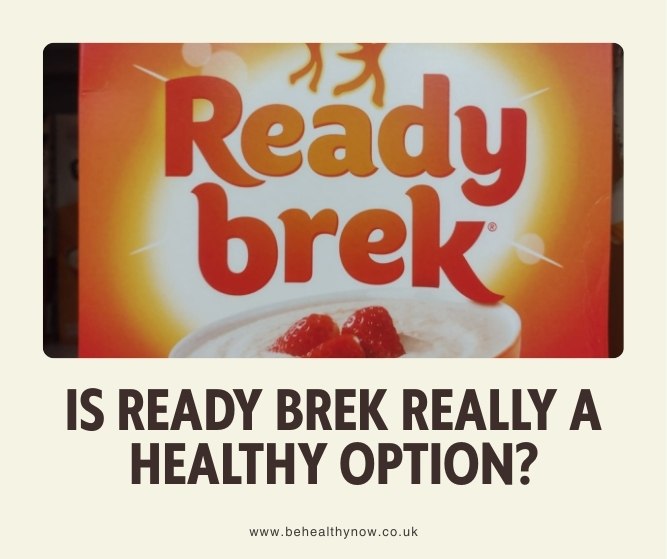
If you’ve been looking at Ready Brek and wondering whether it’s actually a healthy breakfast, it’s a fair question. It sounds wholesome because it’s oats.
So, is Ready Brek healthy?
Yes, Ready Brek Original can be a healthy everyday breakfast. It’s mainly wholegrain oats with no added sugar, and it’s fortified with vitamins and minerals like iron and vitamin D. It’s not very filling on its own though, so add fresh fruit plus a handful of nuts or seeds (or a spoon of almond butter) to make it a more satisfying, balanced breakfast.
What’s in Ready Brek, really?
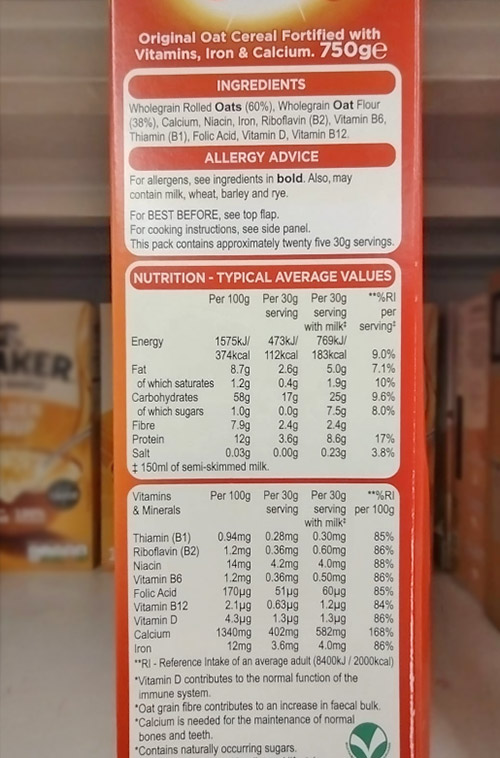
Ready Brek Original is basically wholegrain oats (rolled oats and oat flour), with a few added vitamins and minerals like iron, calcium, vitamin D and several B vitamins.
It’s oat-based, but it may contain traces of wheat, barley and rye (and milk).
If you ever see the Chocolate version, just treat it as a different product because it has added sugar.

What the nutrition label tells you (at a glance)
Per 30g dry serving:
- Carbs: 17g
- Sugar: 0.0g listed per 30g (it’s tiny because it’s 1.0g per 100g, so about 0.3g per 30g)
- Fat: 2.6g
- Fibre: 2.4g
- Protein: 3.6g
- Salt: 0g
- Fortified with: iron, calcium, vitamin D, B vitamins
What’s good: it’s genuinely low in sugar for a cereal, and you’re getting wholegrains.
What’s not so great: it can feel a bit “light” unless you make it more filling (because protein and fibre aren’t huge in a standard bowl).
Related: Highest Fibre Breakfast Cereal: Top 10 Picks in the UK
What about the added vitamins and minerals?
This is one of the big “pros” of Ready Brek. It’s fortified, which just means they add extra vitamins and minerals on top of the oats.
That can be genuinely useful (iron and vitamin D are two common ones people fall short on), but it doesn’t magically make it a perfect breakfast on its own. It still matters what the rest of your day looks like.
You can see exactly what you’re getting in the table below.
RI means Reference Intake. It’s the daily guideline used on UK labels for an average adult, so if you see 25% RI, that serving gives you roughly a quarter of that daily reference amount.
| Nutrient | 30g serving | % RI | 60g bowl | % RI |
| Thiamin (B1) | 0.28mg | ~26% | 0.56mg | ~51% |
| Riboflavin (B2) | 0.36mg | ~26% | 0.72mg | ~52% |
| Niacin (B3) | 4.2mg | ~26% | 8.4mg | ~53% |
| Vitamin B6 | 0.36mg | ~26% | 0.72mg | ~52% |
| Folic acid | 51µg | ~26% | 102µg | ~51% |
| Vitamin B12 | 0.63µg | ~25% | 1.26µg | ~50% |
| Vitamin D | 1.3µg | ~26% | 2.6µg | ~52% |
| Iron | 3.6mg | ~26% | 7.2mg | ~52% |
| Calcium | 402mg | ~50% | 804mg | ~101% |
What to take from this (without overthinking it)
- Even a smaller 30g serving gives you around a quarter of your daily reference intake for most of the added vitamins and iron.
- A more normal bowl (around 60g) gets you about half for those same nutrients.
- Calcium is the stand-out. Ready Brek is very high in calcium because it’s fortified, and if you make it with milk you’ll push that higher again.
So yes, fortification is a real plus, especially if your diet isn’t always perfect. Just don’t rely on it as your main source of nutrients. Think of it as a helpful bonus, not the whole reason to buy it.
How many calories are in a bowl of Ready Brek?
A 30g serving of Ready Brek is 112 calories on its own. If you make it with 150ml semi-skimmed milk, it’s about 183 calories.
But this is the bit that catches people out. The numbers on the box are based on 30g, and for most adults that’s not a “proper bowl”. It’s more like a small portion.
If you double it (which is very easy to do), the calories basically double too. And the milk adds a chunk, depending on what you use.
Here’s the simple comparison:
| Bowl size | Calories (dry) | with 150ml semi-skimmed milk | with 150ml almond milk |
| 30g | 112 kcal | 183 kcal | ~132 kcal |
| 60g | 224 kcal | 295 kcal | ~244 kcal |
If you want fewer calories from the milk, unsweetened almond milk is usually the easiest swap. Almond Breeze Unsweetened is 13 kcal per 100ml, so 150ml adds only about 20 calories.
What if you add fruit or toppings?
Extras can turn Ready Brek into a much more filling breakfast, but not all add-ons do the same job. Fruit is great, but on its own it’s mostly carbs, so it won’t always keep you full for long. If you want it to “stick”, adding protein or healthy fats usually helps most.
A medium banana is about 105 calories, so half is roughly 50–55. A typical tablespoon of almond butter (around 15g) is roughly 94 calories.
Here’s what your bowl roughly turns into:
| Base bowl | Just as it is | + 1/2 banana | + 1 tbsp almond butter | + both |
| 30g + semi-skimmed milk | 183 | ~235 | ~277 | ~329 |
| 30g + Almond Breeze unsweetened | ~132 | ~184 | ~226 | ~278 |
If you’re adding fruit, try pairing it with something protein-based too, like Greek yoghurt, skyr, higher-protein milk, or a scoop of protein yoghurt. That’s usually what turns it from “nice but I’m hungry again” into a proper breakfast.
So, is Ready Brek actually a healthy choice?
If you look at it as a whole, Ready Brek Original is a pretty solid option. It’s oat-based, low in sugar, and the fortification is a nice bonus. Oats also contain beta-glucan fibre, which is the bit people link with cholesterol support, but it’s more of a regular habit thing than something one bowl fixes.
But it’s not perfect, and it’s not going to work for everyone in the same way.
When Ready Brek makes sense
Ready Brek is a good pick if you want something that’s:
- quick and easy
- warm and comforting
- gentle on the stomach (especially if you don’t fancy anything heavy in the morning)
It’s also handy if you want a simple base you can build on, rather than a cereal that’s already sweet and “done”.
When it’s not the best option
Ready Brek is less ideal if you:
- need a high-protein breakfast
- want something that keeps you full for hours without adding anything
- tend to get hungry quickly after carb-heavy breakfasts
That doesn’t mean it’s “bad”. It just means it usually works best when you treat it as a base and add something that brings protein or healthy fats.
And the bigger point (always worth saying): health isn’t about one food. It’s about what you eat most of the time, and how this one breakfast fits into the rest of your day.
How to make Ready Brek more filling
Ready Brek is a good base, but if you eat it plain, it often doesn’t keep you full for long. The fix is simple: add protein, plus a bit of fibre/healthy fat, for example:
- Greek yoghurt or quark (stir it in or add a big spoon on top)
- Milk with more protein, like cow’s milk or soya milk (both tend to be higher in protein than most nut milks)
- Nuts like almonds, walnuts or chopped hazelnuts (great for crunch and staying power)
- Nut butter (almond or peanut butter is an easy one)
- Chia or ground flaxseed (small amount, big difference for fibre)
- Berries (adds fibre and volume without loads of sugar)
If you want the simplest combo: Greek yoghurt + berries + a few nuts. It turns Ready Brek into a proper breakfast instead of just a warm bowl of carbs.
FAQs
Is Ready Brek good for diabetics?
It can work, but it depends on the person. Ready Brek Original has no added sugar and the natural sugars are very low (0.3g per 100g), but it still has carbs (17g per 30g), so it can still raise blood sugar.
If you’re managing diabetes, portion size matters, and it usually helps to add protein/fat (Greek yoghurt, quark, nuts, nut butter) so it’s less “just carbs.” If you’re unsure, it’s worth checking what your own blood sugar does after it.
Is Ready Brek the same as porridge?
Pretty similar, but not identical. Ready Brek is made from rolled oats plus oat flour, so it’s more finely milled and cooks into a smoother bowl.
Porridge oats are usually just rolled oats, so they tend to be a bit more textured and can feel more filling for some people.
Related: The Ultimate Guide to Old Fashioned Oats Vs. Quick Oats
Is Ready Brek gluten-free?
No, it’s not classed as gluten-free. Even though it’s oat-based, the pack warning says it may contain wheat, barley and rye (and milk).
Weetabix also notes that oat products can contain small amounts of other grains, and some people with coeliac disease are sensitive to oats.
Can babies have Ready Brek?
Not under 6 months. Weetabix says Ready Brek isn’t suitable for infants under six months, and NHS guidance also says solids should start from around 6 months.
If you do use it later on, keep it smooth, cool it properly, and use your baby’s usual milk.
Is it good for kids?
Usually yes. It’s a simple oat-based breakfast with no added sugar in the Original, and it’s easy to make it more balanced with fruit, yoghurt, seeds or nuts (if age-appropriate and safe for them).
Just watch sugary toppings if you’re trying to keep breakfast lower in sugar overall.
Is it good for weight loss?
It can be. The main thing is portion size and what you add to it. If you keep it sensible and add filling extras like yoghurt/quark and a few nuts or seeds, it can be a satisfying breakfast that doesn’t feel like “diet food.”
You may also want to read this:
Ready Brek vs Porridge Oats
Is Alpen Muesli Good for You?
Is Special K Healthy?
Is Weetabix Healthy?
Are Bran Flakes Good For You?
Kellogg’s All-Bran Cereal

Petra Nakashian (previously Kravos) has been writing about health and healthy living for over 10 years. She covers nutrition, natural health, and everyday wellness topics, with a focus on clear, practical advice you can actually use. Petra enjoys digging into health books, studies, and reputable research to check health claims, because there’s a lot of advice online that sounds convincing but isn’t accurate.