

If you’re experiencing burning, tingling, numbness or nerve pain, you may have come across magnesium as something that could help. There is some research to support this.
Magnesium is important for normal nerve function, and low levels can cause symptoms such as numbness and tingling.
Some studies have also found benefits in people with nerve damage caused by diabetes.
However, the research is still limited, and magnesium won’t necessarily help every type of nerve pain. In this guide, I’ll look at what the studies show and which forms of magnesium may be worth considering.
Does Magnesium Actually Help Neuropathy?
Possibly, in some people. But whether magnesium helps is likely to depend on why you have the nerve symptoms in the first place.
Neuropathy simply means that nerves are damaged or not working as they should. It can cause burning, tingling, numbness, pins and needles or shooting pain.
There are a few different situations to consider.
If you’re low in magnesium
Magnesium is important for normal nerve and muscle function. As magnesium deficiency becomes more severe, it can cause symptoms such as numbness, tingling, muscle contractions and cramps, according to the National Institutes of Health.
So, if low magnesium is contributing to your symptoms, correcting the deficiency may help. But that is different from saying magnesium can treat every type of nerve damage.
If you have nerve damage caused by diabetes
This is where some of the more encouraging human research comes from.
A five-year study in people with type 1 diabetes who were chronically low in magnesium found that nerve problems were much less likely to get worse in those taking magnesium.
A newer study of magnesium citrate in people with type 2 diabetes and nerve damage also found greater improvement with magnesium than with placebo over eight weeks.
We’ll look at these studies more closely later in the article.
If your nerve pain has another cause
Here, the evidence is much less clear.
For example, a small study of oral magnesium in people with nerve pain found no clear overall improvement compared with placebo after one month.
That was a short study, so it doesn’t tell us what might happen with longer-term supplementation, particularly in someone who starts out low in magnesium. But it does show that magnesium isn’t a reliable pain treatment for everyone.
So, based on the research we have so far, magnesium may help in some situations, particularly when low magnesium or diabetes is involved, but it isn’t yet a proven treatment for neuropathy in general.
Why Might Magnesium Help With Nerve Pain?
There are a few reasons why magnesium could affect nerve pain, although this doesn’t mean that taking a magnesium supplement will necessarily help everyone.
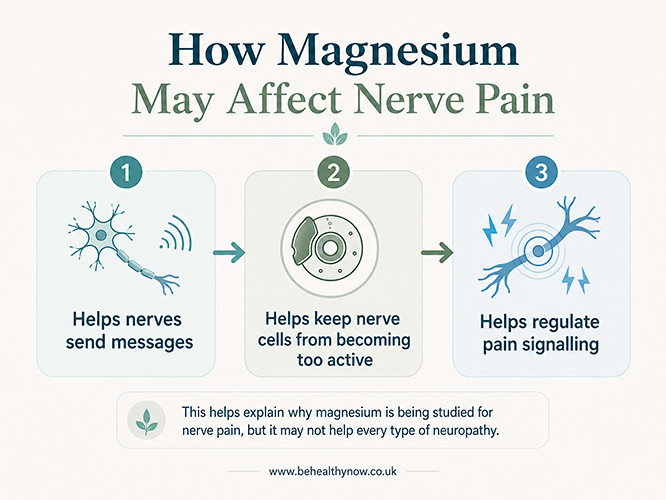
Magnesium helps nerves send messages properly
Your nerves are constantly sending messages around your body, including messages about touch, movement and pain. Magnesium is one of the minerals that helps these messages travel normally between nerves and muscles. The National Institutes of Health explains that magnesium is involved in normal nerve function and nerve signalling.
When magnesium becomes very low, this signalling can become less well controlled. Nerves and muscles can become more easily triggered than they should be, which can lead to symptoms such as tingling, muscle twitching, spasms or cramps. More severe magnesium deficiency can also cause numbness.
This helps explain why low magnesium can sometimes produce symptoms that feel very similar to nerve problems.
Magnesium helps keep nerve cells from becoming too active
Nerve cells also rely on minerals such as calcium and magnesium to work properly. Calcium helps nerve cells send signals, while magnesium helps control how much calcium enters the cells.
You can think of magnesium as helping to put a brake on nerve activity. Without enough of that control, nerve cells can become more easily excited and pain signals may become stronger or easier to trigger. Researchers believe this is one reason magnesium may influence pain. Research into magnesium and pain has looked closely at this effect.
Magnesium also helps control pain signals
One way magnesium does this involves something called NMDA receptors. These are found on nerve cells and help control how those cells communicate with each other. They are also involved in the way our nervous system processes pain.
You don’t really need to remember the name. The important point is that magnesium naturally helps keep these receptors under control. If they become too active, pain signals can become stronger and the nervous system can become more sensitive to pain.
These effects help explain why researchers are interested in magnesium for nerve pain, but they don’t mean that taking extra magnesium will necessarily help if you already have enough.
How Do You Know If You’re Low in Magnesium?
Tingling or numbness alone can’t tell you whether you are low in magnesium, as these symptoms can have many other causes.
Can a blood test show low magnesium?
A blood test can measure magnesium, but it isn’t a perfect way of judging how much magnesium is stored in the body.
Most magnesium is found inside our cells and bones, while only a very small amount circulates in the blood. This means a blood magnesium level can sometimes look normal even when overall magnesium stores are not ideal.
Doctors may therefore look at the bigger picture, including your blood magnesium level, what you normally eat, any medications you take, other symptoms and health conditions that can affect magnesium levels.
Who is more likely to be low in magnesium?
Low magnesium may be more likely in people with digestive conditions that affect absorption, type 2 diabetes and older adults. Certain medicines can also affect magnesium levels, including some diuretics and long-term use of proton pump inhibitors, which are commonly used to reduce stomach acid.
Don’t assume tingling means low magnesium
The main thing is not to assume tingling or numbness means you are low in magnesium. If these symptoms are persistent, getting worse or accompanied by weakness, it is worth looking for the underlying cause rather than simply taking more magnesium.
Magnesium and Diabetic Neuropathy
Diabetes is one area where the connection between magnesium and nerve problems becomes particularly interesting.
Diabetic neuropathy simply means nerve damage caused by diabetes. Over time, high blood sugar can damage both the nerves and the small blood vessels that supply them. This often causes symptoms such as tingling, numbness, burning or pain, particularly in the feet and legs. You can read more about how diabetes damages nerves from the National Institute of Diabetes and Digestive and Kidney Diseases.
Why magnesium may matter more if you have diabetes
There is another piece to the puzzle. People with type 2 diabetes are also more likely to have low or inadequate magnesium.
One reason is that when blood sugar is high, the kidneys can produce more urine and more magnesium may be lost from the body along with it. The NIH lists people with type 2 diabetes as one of the groups at greater risk of magnesium inadequacy.
This doesn’t mean that low magnesium is necessarily causing the nerve damage. But it does raise an interesting question: if someone with diabetes is also low in magnesium, could correcting that deficiency help protect their nerves or slow down further problems?
What did the five-year magnesium study find?
Earlier, I mentioned a particularly interesting five-year study of people with type 1 diabetes and long-term magnesium depletion.
The researchers started with 110 people who were chronically low in magnesium. Half were given 300 mg of magnesium a day, while the others received no magnesium supplement. Ninety-seven people completed the full five years.
The difference at the end was quite striking. Nerve problems worsened in 12% of the magnesium group compared with 61% of the group that didn’t take magnesium. Some people taking magnesium also improved rather than simply staying stable.
There was another interesting finding. Some abnormal nerve-test results returned to normal, but this was only seen in people whose nerve problems were still at an early stage.
This doesn’t prove that magnesium can reverse established nerve damage. What it does suggest is that, in people with diabetes who are genuinely low in magnesium, restoring magnesium over the long term may help slow down or improve some early nerve problems.
A newer study of magnesium citrate
A much newer study looked specifically at magnesium citrate in people with type 2 diabetes and nerve damage.
Sixty people took part. Half received 300 mg of magnesium citrate daily and half received a placebo for eight weeks. Their nerve problems were assessed using a score based on things such as sensation and reflexes.
After two months, the improvement from the start of the study was greater in the magnesium group than in the placebo group. The magnesium group’s score fell by an average of 1.27 points, compared with 0.30 points in the placebo group.
That is encouraging, particularly as this study looked directly at people who already had diabetes-related nerve problems.
However, it was still only 60 people followed for eight weeks. That’s a useful starting point, but I would like to see the same result repeated in much larger studies and over several months or longer before drawing firm conclusions.
Lower magnesium has also been linked with poorer nerve function
One study of 978 people with type 2 diabetes found that lower blood magnesium was linked with poorer nerve function, even after factors such as age, diabetes duration and blood sugar control were taken into account.
However, this type of study can show a connection, but it cannot prove that low magnesium caused the nerve problems.
So, what does this tell us?
The research gives us a good reason to pay attention to magnesium in people with diabetes and nerve problems. The strongest long-term study was in people who were already low in magnesium, while the newer magnesium citrate study was encouraging but small and short.
We still can’t say that magnesium treats diabetes-related nerve damage in everyone. But if someone with diabetes is also low in magnesium, correcting that deficiency may be particularly important.
What About Other Types of Nerve Pain?
Most of the more encouraging research on magnesium and neuropathy has been in people with diabetes. For other types of nerve pain, the evidence is much more limited.
Sciatica and nerve pain from the back
Sciatica usually happens when a nerve in the lower back becomes irritated or compressed, causing pain that can travel through the buttock and down the leg.
One study looked at magnesium in people with long-term lower back pain that also involved nerve pain. Participants received magnesium through a vein for two weeks, followed by oral magnesium for another four weeks. Pain improved more in the magnesium group, and the benefit lasted during follow-up.
However, this wasn’t a simple study of taking a magnesium supplement for sciatica. The treatment started with intravenous magnesium, and participants were also taking other pain medicines.
So, while the results are interesting, we don’t currently have good evidence that taking oral magnesium on its own will relieve sciatica or other nerve pain caused by an irritated or compressed nerve.
If you’re looking at other options too, I’ve also reviewed several natural remedies for nerve pain, including what the research says about each one.
Which Magnesium Is Best for Neuropathy?
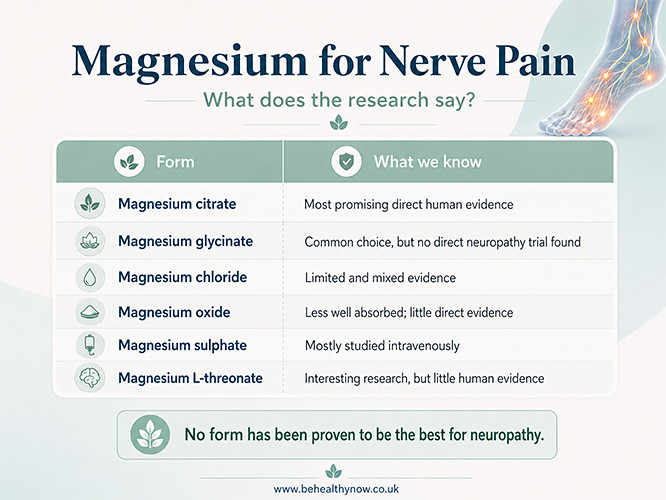
This is where things become a little less straightforward. You will often see particular forms, especially magnesium glycinate, recommended for nerve pain online. But there isn’t currently enough research to say that one type of magnesium is definitely the best for neuropathy.
Some forms have been studied directly for nerve problems, while others haven’t. That doesn’t necessarily mean the unstudied forms won’t help. It simply means we have less evidence to go on.
| Type of magnesium | What do we know about nerve pain? | My take |
|---|---|---|
| Magnesium citrate | A small 2026 study found improvement in people with diabetes-related nerve damage | Promising and well absorbed, but not proven to be the best |
| Magnesium glycinate | I couldn’t find a human trial testing it specifically for neuropathy | Could still be a reasonable choice, but there is no evidence that it has a special advantage for nerve pain |
| Magnesium chloride | One short oral study found no clear overall improvement in nerve pain | Well absorbed, but evidence for neuropathy is limited |
| Magnesium oxide | Used as part of one treatment programme for nerve-related back pain | Less well absorbed than some other forms and hasn’t been shown to work on its own for neuropathy |
| Magnesium sulphate | Most relevant nerve-pain research has used it intravenously | Medical IV treatment isn’t the same as taking an oral supplement |
| Magnesium L-threonate | Interesting animal research, but very little relevant human evidence | Not enough evidence to recommend it specifically for neuropathy |
Magnesium citrate
Magnesium citrate currently has some of the most directly relevant research because it was the form used in the 2026 study of people with type 2 diabetes and nerve damage. Participants taking magnesium citrate for eight weeks improved more than those taking a placebo.
It is also one of the forms that tends to be absorbed relatively well. The NIH lists magnesium citrate among the more easily absorbed forms of magnesium, along with chloride, lactate and aspartate.
Does this make citrate the best magnesium for neuropathy? Not yet. We only have a small, short study directly testing it for diabetes-related nerve problems, and it wasn’t compared with other forms of magnesium.
Magnesium glycinate
Magnesium glycinate is probably one of the forms you are most likely to see recommended for nerve pain.
However, I couldn’t find a human clinical trial testing magnesium glycinate specifically as a treatment for neuropathy.
That is important, but it doesn’t mean glycinate cannot help. If someone is low in magnesium and glycinate successfully increases their magnesium intake, it could still be useful. What we don’t know is whether glycinate has any special benefit for nerve pain compared with other forms.
So I wouldn’t call magnesium glycinate the “best magnesium for neuropathy” based on the research we currently have.
Magnesium chloride
Magnesium chloride is another form that is generally well absorbed. The NIH includes chloride among the forms with relatively good bioavailability.
It has also been tested directly in people with nerve pain. In a small study of 45 people with neuropathic pain, oral magnesium chloride was taken for one month. Overall pain relief wasn’t significantly better than placebo.
As we discussed earlier, though, one month is a very short study, particularly if some people started out low in magnesium. So I wouldn’t take this as proof that magnesium chloride cannot help. It simply means this particular trial didn’t find a clear overall benefit within four weeks.
Magnesium oxide
Magnesium oxide contains a relatively high proportion of elemental magnesium, but that doesn’t necessarily mean your body absorbs more of it.
In fact, magnesium oxide tends to be less well absorbed than forms such as citrate and chloride.
Magnesium oxide was used in the study we discussed earlier on nerve-related lower back pain, but it was given after two weeks of intravenous magnesium and alongside another form of oral magnesium and pain medication. So that study doesn’t tell us that magnesium oxide itself treats neuropathy.
This is also a good example of why supplement labels can be confusing. A product may say something like “magnesium glycinate 500 mg”, but that doesn’t necessarily mean you are getting 500 mg of magnesium. What matters is the amount of elemental magnesium it provides. I explain this in more detail in my guide to elemental magnesium.
Magnesium sulphate
Magnesium sulphate has been studied for several types of pain, including nerve pain, but much of this research involves magnesium given through a vein in a medical setting rather than as an everyday supplement.
A recent review concluded that magnesium sulphate may have potential for neuropathic pain, but that there still isn’t enough evidence to support its routine use.
So I wouldn’t use the results of intravenous magnesium sulphate studies as a reason to choose an oral magnesium sulphate supplement.
Magnesium L-threonate
Magnesium L-threonate gets a lot of attention because much of the research around this form has focused on the brain and nervous system.
There is also some interesting animal research involving nerve pain. For example, magnesium L-threonate has reduced pain-related responses in rats with irritated spinal nerves. But animal studies can’t tell us whether the same thing will happen in people.
Human research is much less convincing. In one 12-week trial of magnesium L-threonate for persistent pain after breast cancer surgery, it didn’t provide better pain relief than placebo.
So although L-threonate is an interesting form of magnesium, we don’t currently have good evidence that it is better for neuropathy or nerve repair than other forms.
So, which magnesium would I choose for nerve pain?
Based on the research we have today, I don’t think we can name one form as the clear winner.
Magnesium citrate stands out because it has some direct positive research in diabetes-related nerve problems and is relatively well absorbed.
Magnesium glycinate may also be a reasonable choice if you tolerate it well, but we don’t yet have direct clinical evidence showing that it has a special advantage for neuropathy.
Perhaps the most important point is this: if low magnesium is contributing to your symptoms, correcting that deficiency may matter more than finding a supposedly “nerve-specific” form of magnesium.
Can Magnesium Oil or Cream Help Nerve Pain?
Magnesium oil, sprays and creams are applied directly to the skin. Despite the name, magnesium oil isn’t actually an oil. It is usually magnesium chloride dissolved in water.
One small 2023 study looked at magnesium chloride spray in people with nerve problems and advanced kidney disease. Symptoms improved over 12 weeks, but only 14 people completed the study and there was no placebo group. So we can’t be sure how much of the improvement was actually due to the magnesium spray.
Does magnesium actually get through the skin?
We still don’t really know how much magnesium gets through healthy skin.
A small placebo-controlled study of magnesium cream found some signs that magnesium may have been absorbed, but the results weren’t strong enough to show that creams are a reliable way of increasing magnesium levels. A review of transdermal magnesium also found that there wasn’t convincing evidence that enough magnesium is absorbed through the skin to make a meaningful difference.
So, at the moment, there isn’t enough good-quality research to say that magnesium oil, spray or cream will help nerve pain. If the aim is to correct low magnesium, oral magnesium is much better studied.
How Much Magnesium Should You Take for Nerve Pain?
There isn’t an established magnesium dose for nerve pain or neuropathy. Studies have used different amounts and different forms, so we can’t take one research dose and assume it will work for everyone.
Research doses have varied. The five-year diabetes study used 300 mg of magnesium a day, while the newer study used 300 mg of magnesium citrate daily for eight weeks.
Importantly, the newer study describes this as 300 mg of magnesium citrate rather than clearly stating that it provided 300 mg of elemental magnesium.
These are examples of doses used in research, not recommendations for treating nerve pain.
Pay attention to elemental magnesium
This is where magnesium labels can get confusing.
For example, “500 mg magnesium glycinate” does not necessarily mean you are getting 500 mg of magnesium. The magnesium is attached to another substance, and only part of that compound is magnesium.
What you really want to know is how much elemental magnesium the supplement provides. I explain how to find this on the label, with examples for different magnesium forms, in my guide to elemental magnesium.
This is also why comparing the number of milligrams used in different studies can be misleading unless we know whether the researchers mean elemental magnesium or the weight of the whole magnesium compound.
How much magnesium is considered safe?
For general guidance, UK adults aged 19 to 64 need around 300 mg of magnesium a day for men and 270 mg for women, including magnesium from food.
The NHS says that taking more than 400 mg a day from magnesium supplements for a short time can cause diarrhoea. It also says there isn’t enough evidence to know what the effects of taking high supplemental doses for a long time might be.
US guidance is slightly different. The NIH sets an upper limit of 350 mg a day for magnesium from supplements and medicines for adults. Magnesium naturally present in food doesn’t count towards this limit.
These figures are safety guidelines, not recommended doses for neuropathy. Taking more magnesium doesn’t necessarily mean it will work better for nerve pain.
Be more careful if you have kidney problems or take medication
Healthy kidneys are normally very good at getting rid of excess magnesium. If kidney function is reduced, however, magnesium can build up in the body. The NIH notes that the risk of magnesium toxicity increases with impaired kidney function or kidney failure.
Magnesium supplements can also interfere with some medicines, including certain antibiotics and medicines for osteoporosis. Some diuretics and long-term use of acid-reducing medicines can also affect magnesium levels.
So if you have kidney disease, take regular medication or are considering a higher dose of magnesium because of ongoing nerve symptoms, it is worth checking with your doctor or pharmacist first.
For everyone else, the main takeaway is simple: there is no proven “nerve pain dose” of magnesium. The amount of elemental magnesium you are actually getting, whether you are low in magnesium to begin with, and the cause of your nerve symptoms are more important than simply taking a high dose.
Can Magnesium Repair Nerves or Reverse Neuropathy?
At the moment, we don’t have good human evidence that taking magnesium can regrow a damaged nerve or completely reverse established neuropathy.
That doesn’t mean nerves can never recover. Some nerves can heal or regrow to some extent if the underlying cause of the damage is found and treated.
How much recovery is possible depends on what caused the nerve damage, how severe it is and how long it has been there. The National Institute of Neurological Disorders and Stroke explains that some neuropathies can improve when the underlying cause is corrected.
Magnesium may be more helpful earlier on
There is one encouraging finding from the five-year magnesium study in people with type 1 diabetes and low magnesium.
Some people who had early signs of nerve problems had abnormal nerve-test results return to normal while taking magnesium. However, this wasn’t seen in people whose neuropathy was already more established.
This is an important distinction. It suggests magnesium may help protect nerve function or improve some early changes when low magnesium is part of the problem, but it doesn’t show that magnesium can rebuild nerves that have already been badly damaged.
Treating the cause is still the most important part
Whether nerves can recover depends a lot on why they were damaged in the first place.
For example, that might mean correcting a nutrient deficiency, improving blood sugar control in diabetes, relieving pressure on a trapped nerve or reviewing a medication that may be contributing to the problem.
Frequently Asked Questions
Does magnesium help neuropathy in the feet?
Possibly, depending on the cause. There is some encouraging research in diabetes-related nerve problems, which often affect the feet, but magnesium hasn’t been shown to treat every type of foot neuropathy.
Does magnesium help neuropathy in the hands?
There isn’t good evidence that magnesium specifically treats nerve problems in the hands. Whether it helps is more likely to depend on the cause and whether you are low in magnesium.
What is the best magnesium for numbness and tingling?
No form is proven to be best. If numbness or tingling is related to low magnesium, correcting the deficiency may matter more than choosing a particular form.
Can too much magnesium cause neuropathy?
Too much magnesium isn’t recognised as a usual cause of chronic neuropathy. High supplemental doses are more likely to cause diarrhoea, nausea and stomach cramps, while very high levels can cause muscle weakness, low blood pressure and heart or breathing problems. The risk is higher if your kidneys aren’t working properly. You can read more in the NIH magnesium safety guidance.
Who is more likely to be low in magnesium?
Low magnesium is more common in people with some digestive conditions, type 2 diabetes and older adults. Certain medicines, including some diuretics and long-term proton pump inhibitors, can also affect magnesium levels. The NIH lists the main groups at higher risk of low magnesium.